USEFUL SCIENCE
Sharing Atoms

Because they are so long lived, atoms really get around. Every atom you possess has almost certainly passed through several stars and been part of millions of organisms on its way to becoming you. We are each so atomically numerous and so vigorously recycled at death that a significant number of our atoms – up to a billion for each of us, it has been suggested – probably once belonged to Shakespeare. A billion more each came from Buddha and Genghis Khan and Beethoven, and any other historical figure you care to name. (The personages have to be historical, apparently, as it takes the atoms some decades to become thoroughly redistributed; however much you may wish it, you are not yet one with Elvis Presley.)
— Bill Bryson, A Short History of Nearly Everything
— 2004 winner, Aventis Prize for best general science book
— 2005 winner, EU Descartes Prize for science communication
Atoms and Cells
How many atoms and cells do I have in me?
Average adult American, 20 years and older:
Height
Weight
Men
5 feet, 9 inches
195 lbs.
Women
5 feet, 4 inches
166 lbs.
Avg. (51%f, 49%m)
5 feet, 6 inches
180 lbs.
Number of atoms in the average adult American body:
8,200,000,000,000,000,000,000,000,000 — that's 8.2 octillion
1 octillion = 1 thousand trillion trillion, or 1027
Latest estimate of the number of stars in the universe:
100,000,000,000,000,000,000,000,000,000 — 100 octillion
Number of cells in the average adult American body:
40,800,000,000,000 — that's 40.8 trillion
Latest estimate of the number of stars in the Milky Way galaxy:
100,000,000,000 — one hundred billion (.1 trillion)
Latest estimate of number of trees on Earth:
3,000,000,000,000 — 3 trillion
| Height | Weight | |
| Men | 5 feet, 9 inches | 195 lbs. |
| Women | 5 feet, 4 inches | 166 lbs. |
| Avg. (51%f, 49%m) | 5 feet, 6 inches | 180 lbs. |
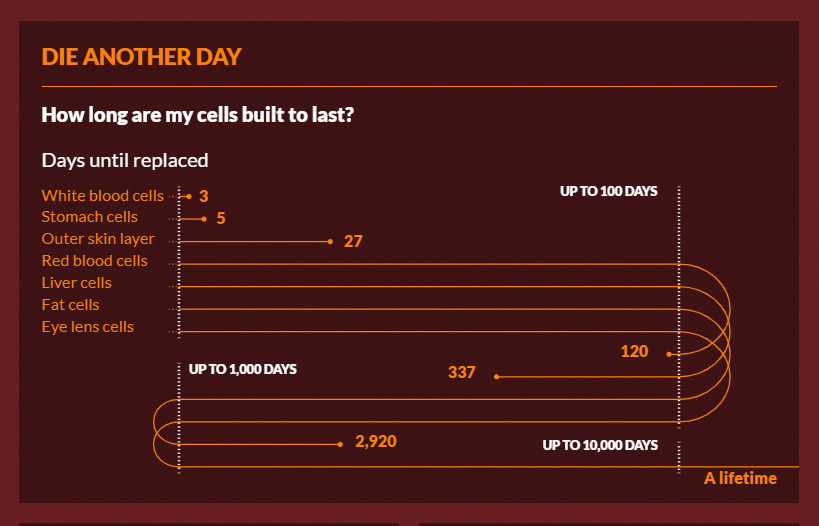
How often are my cells replaced?
How can I find out exactly what's in my body?
Check out this link for an interactive presentation tailored to you. [The BBC Earth site has removed this interactive experience, but I've got you covered. The link below goes to the Wayback Machine (The Internet Archive), so you can still get a personalized accounting of just what's in you.]
Earth in a Year
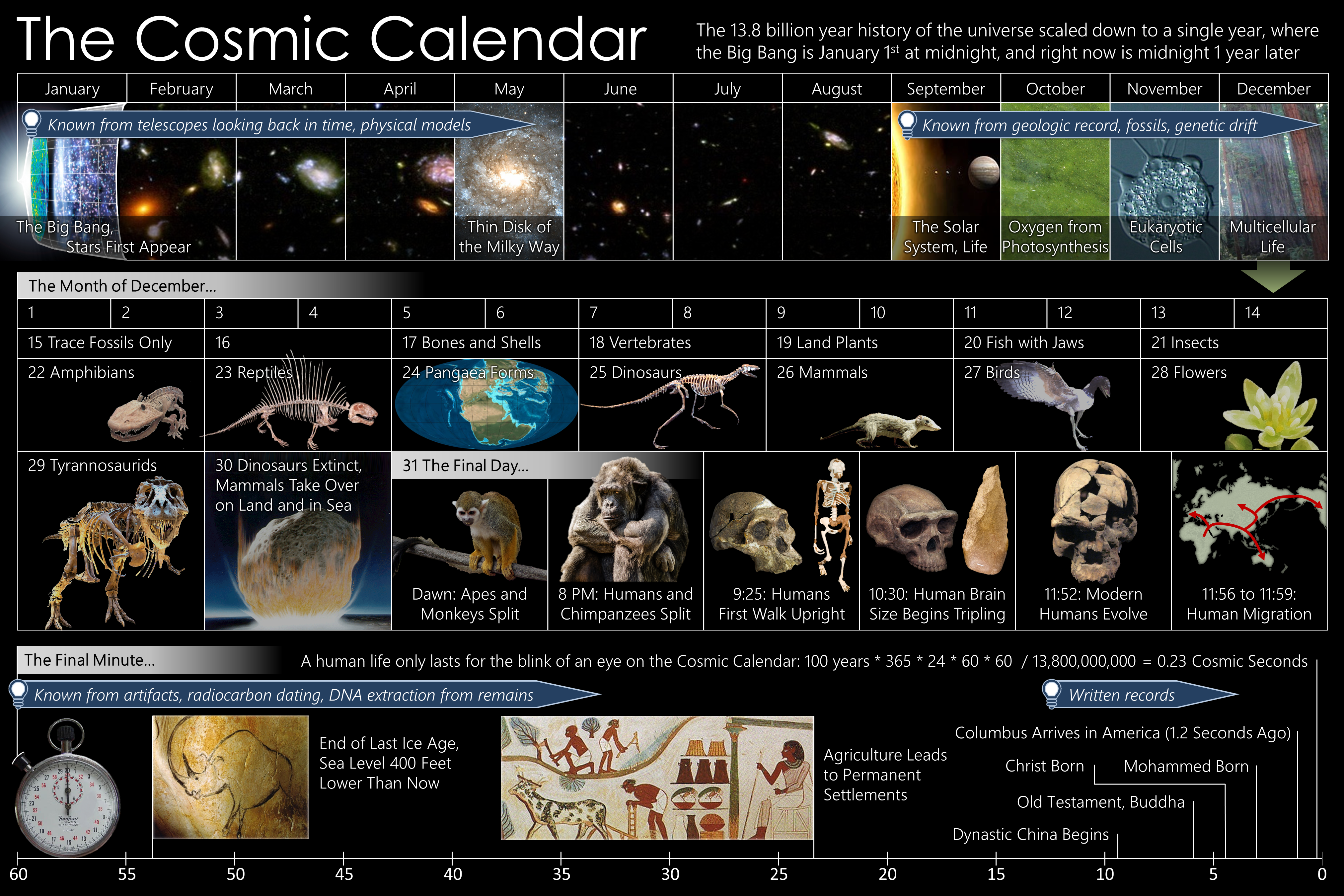
Geologists will sometimes use the calendar year as a unit to represent the time scale, and in such terms the Precambrian runs from New Year's Day to well after Halloween. Dinosaurs appear in the middle of December and are gone the day after Christmas. The last ice sheet melts on December 31st at one minute before midnight, and the Roman Empire lasts five seconds.
— John McPhee, Basin and Range, p. 126.
Earth in a Day
If you imagine the 4.5-billion-odd years of Earth's history compressed into a normal earthly day, then life begins very early, about 4 a.m., with the rise of the first simple, single-celled organisms, but then advances no further for the next sixteen hours. Not until almost 8:30 in the evening, with the day five-sixths over, has Earth anything to show the universe but a restless skin of microbes. Then, finally, the first sea plants appear, followed twenty minutes later by the first jellyfish and the enigmatic Ediacaran fauna first seen by Reginald Sprigg in Australia. At 9:04 p.m. trilobites swim onto the scene, followed more or less immediately by the shapely creatures of the Burgess Shale. Just before 10P.M. plants begin to pop up on the land. Soon after, with less than two hours left in the day, the first land creatures follow.
Thanks to ten minutes or so of balmy weather, by 10:24 the Earth is covered in the great carboniferous forests whose residues give us all our coal, and the first winged insects are evident. Dinosaurs plod onto the scene just before 11 p.m. and hold sway for about three-quarters of an hour. At twenty-one minutes to midnight they vanish and the age of mammals begins. Humans emerge one minute and seventeen seconds before midnight. The whole of our recorded history, on this scale, would be no more than a few seconds, a single human lifetime barely an instant.
— Bryson, pp. 125-126.
Earth in Your Arms
Perhaps an even more effective way of grasping our extreme recentness as a part of this 4.5-billion-year-old picture is to stretch your arms to their fullest extent and imagine that width as the entire history of the Earth. On this scale, according to John McPhee in Basin and Range, the distance from the fingertips of one hand to the wrist of the other is Precambrian [before even algae and simple invertebrates, like jellyfish & worms, arthropods, brachiopods, & trilobites]. All of complex life is in one hand, "and in a single stroke with a medium-grained nail file you could eradicate human history."
— Bryson, p. 213.
The Difference between Millions and Billions
1 million seconds is 11 days; 1 billion seconds is 31 years.
If you wanted to earn one billion dollars ($1,000,000,000.00), you could do so with an hourly wage. Let's say you worked at the job of your dreams for the overwhelming sum of $2000/hour, and worked full time, 40 hours per week, 52 weeks per year. You'd make $4,160,000 in a year.
You could have started working your full-time $2000/hour job at the signing of the US Constitution in 1787, and you still wouldn't have made your billion yet.
You'd finally make a billion dollars in 2028, after working for 241 years straight.
Some Visual Timelines
click on the images for a larger view
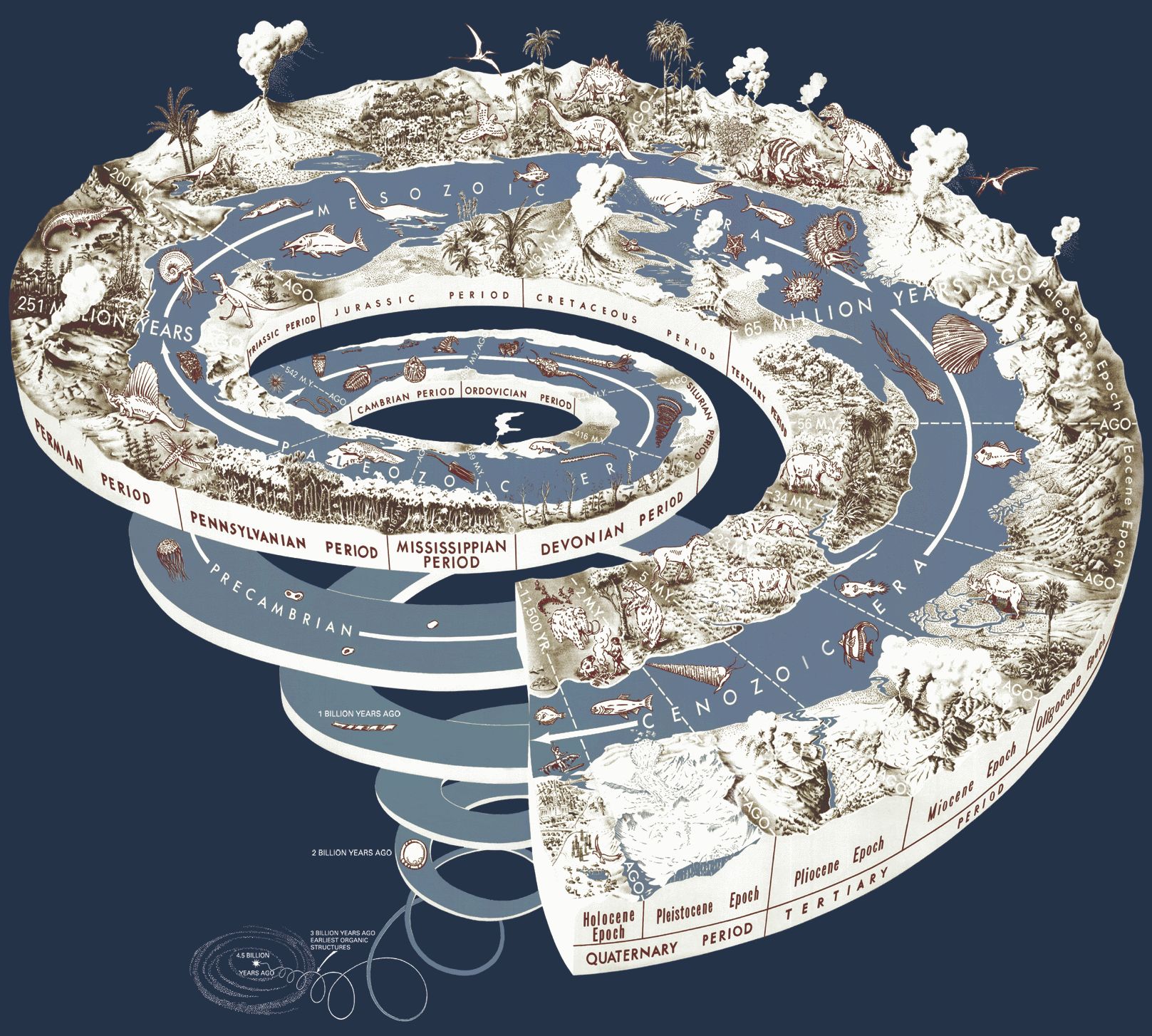
A Timeline of Life on Earth
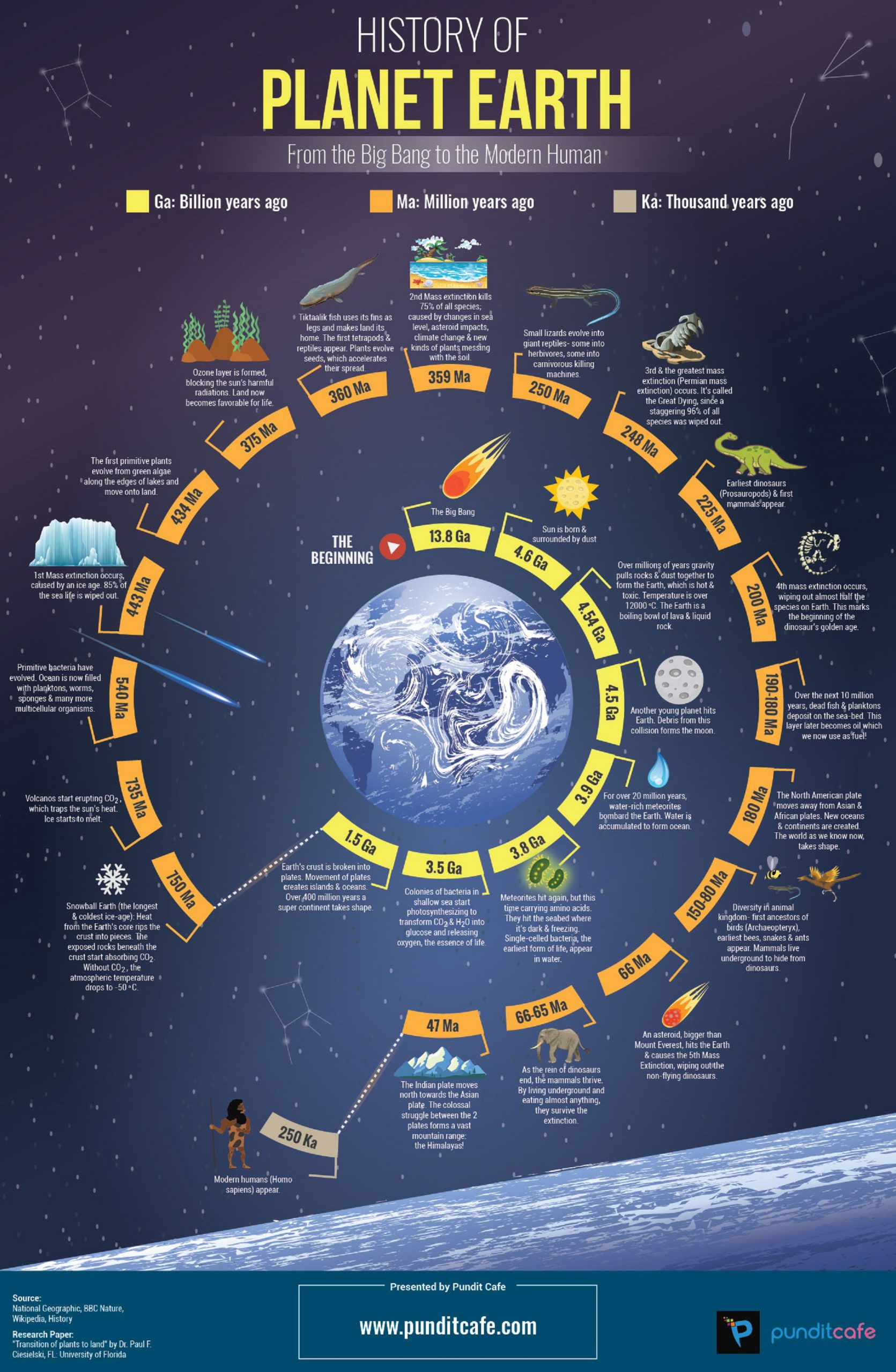
A Timeline of Earth Itself
The History of the Universe in a Year