TIMELINE OF IRISH LITERATURE
from 600 BCE to 1850 CE
PRE-CHRISTIAN ORAL TRADITION — c. 600 BCE - c. 431 CE
SAH-win
Dún Aonghasa
DOON ANG-hoss ə
Lebor Gabála Érenn
LʸOW-ur (rhymes with "flower") gəWAUL-ə Eh-rehn
Túatha Dé Danann
TOO-əth-ə DAY DA-nənn
faoi ceilt
fwee kelt
seanchaí
SHAN-ə-ɣee
Seanchaithe
SHAN-ə-ɣoy-teh
sgéalí
SHEE-lee
filí
FILL-ə
filid
FILL-lid
filidecht
fill-ə-DEɣ
áes dána
ice DAHN-ə
áes cerda
ice KEHR-də
scéla
SHKEH-lə
scél
shkale
Context
Fair warning: almost everthing we know about these prehistoric periods is problematic. Our understanding of them is based on scanty and sometimes contradictory evidence.
The Mesolithic
Archeological evidence suggests that Ireland has been continuously inhabitied since the start of the Mesolithic (Middle Stone Age) period in Europe, about 8,000 BCE. The ice sheet that had covered most of Europe during the Paleolithic period had receded to Scandinavia and what we'd now call the Scottish Highlands. Ireland was joined by a land bridge to Britain, which itself was still part of the European land mass. Archeologists are in agreement that Mesolithic peoples maintained continuity in their cultures and their technologies with their Paleolithic ancestors, but the distinction between the cultures of the two periods was the Mesolithic development of adaptations to specific local environments. Because of this need to adapt to local conditions, Mesolithic material culture (tools, weapons, utensils, machines, ornaments, art, buildings, monuments, clothing, etc.) had far greater innovation and diversity than those elements had in the Paleolithic period.
The Neolithic
The Neolithic period in Ireland began about 3000 BCE. There are a number of sites that date from this period. These are some of my favorites.
Carrowmore Megalithic Cemetery
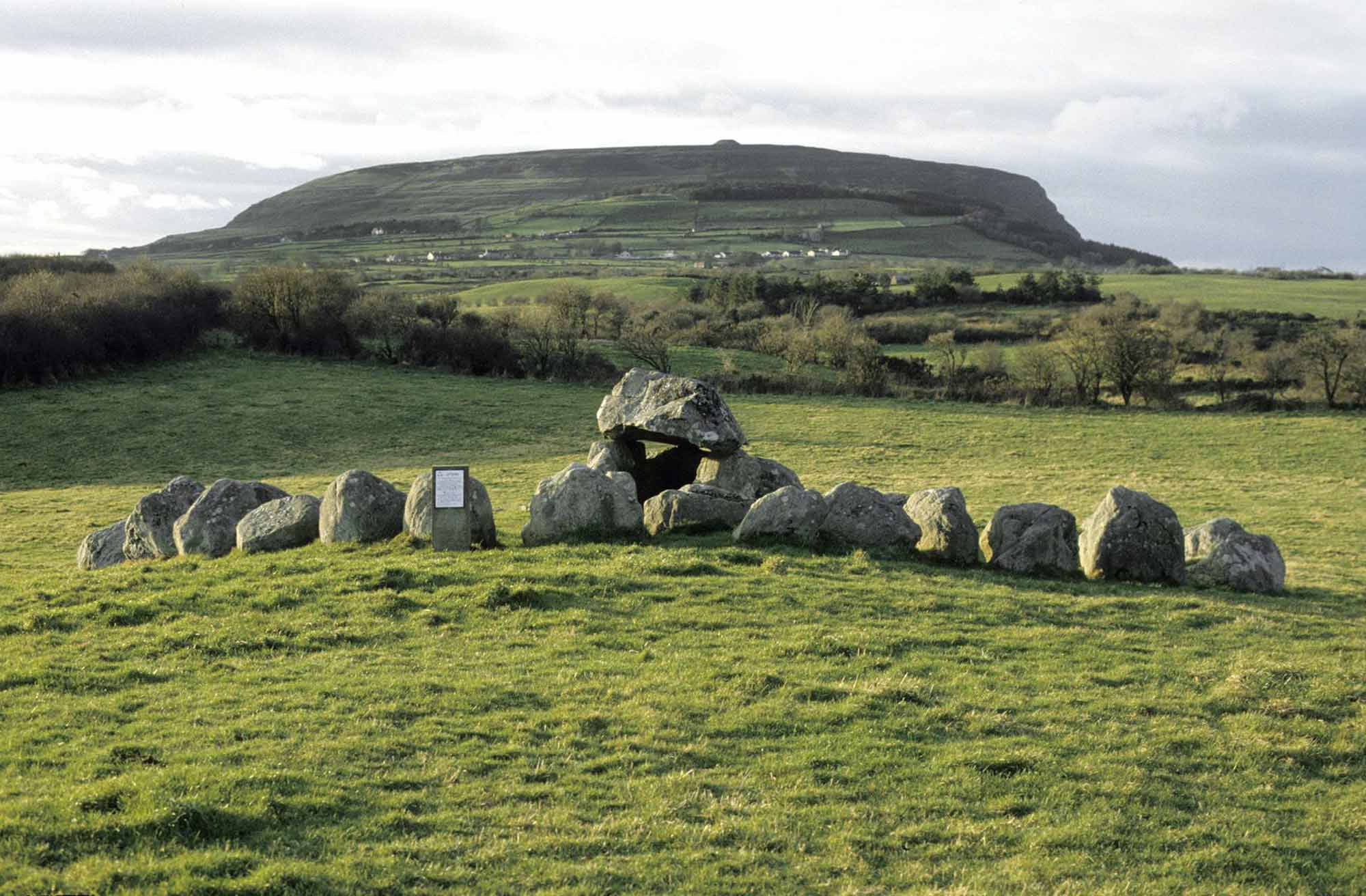
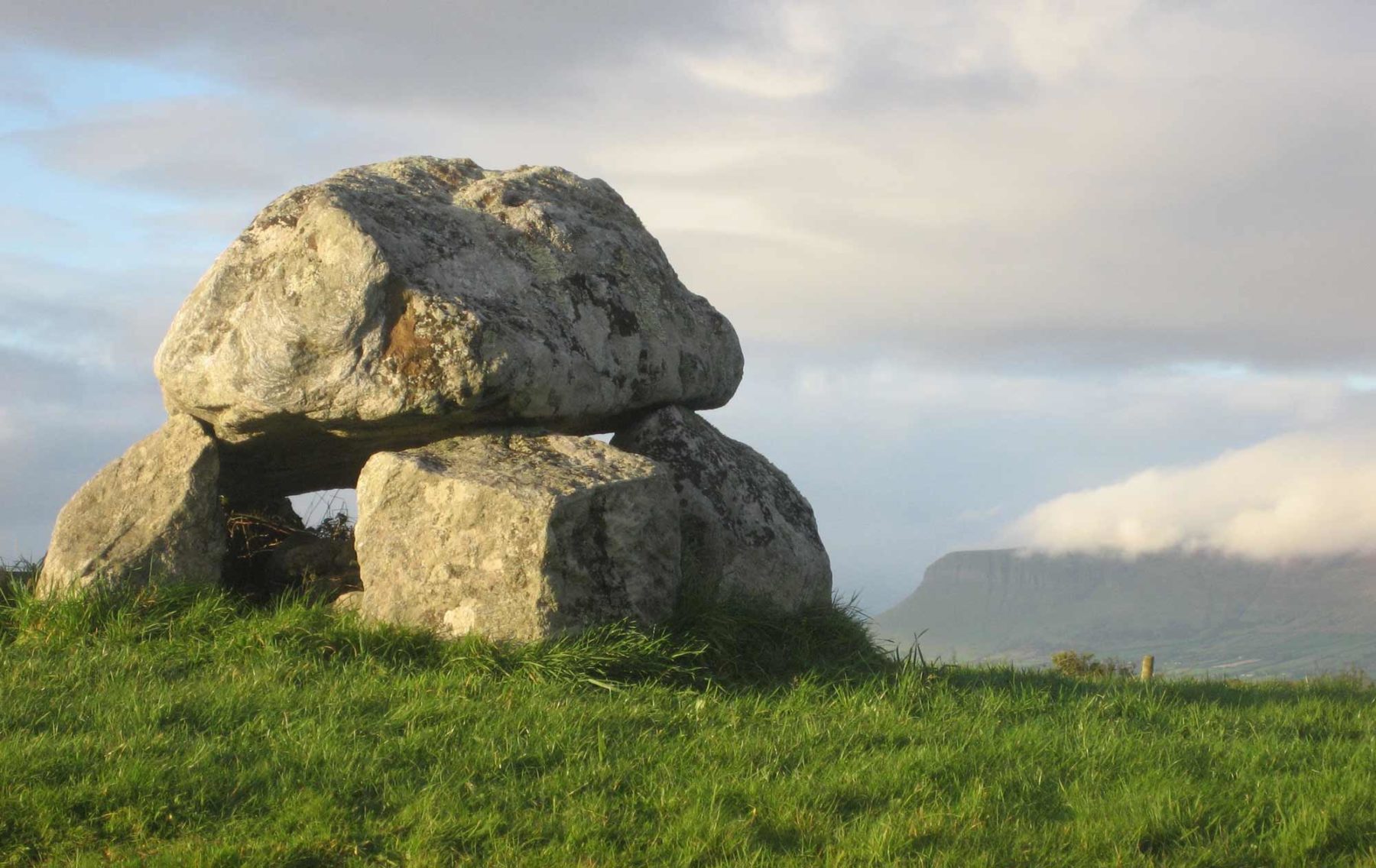
The Carrowmore Megalithic Cemetery, in Co. Sligo has the oldest and the densest concentration of Neolithic tombs in Ireland. There are about 60 sites forming a nucleus at the center of this valley on a peninsula in Sligo Bay. All of these sites surround a central monument, Listoghil, and the majority of them were built to point to it. On the edges of the valley are low hills that have passage tombs on their summits. During Samhain (the Gaelic festival that marks the end of the harvest season and the beginning of winter, on October 31/November 1), the sun rises above a natural saddle in the Ballygawley Mountains, directly in line with the chamber of Listoghil at Carrowmore. At the moment of sunrise, the underside of the tilted roof of the chamber is lit, and a pointed stone at the front of the chamber casts a long shadow along the centerline of the slab. As the sun continues to rise, this shadow proceeds across the roof-slab, shortening all the while, until it is finally blocked by the shadow of the walls.
The Poulnabrone Dolmen
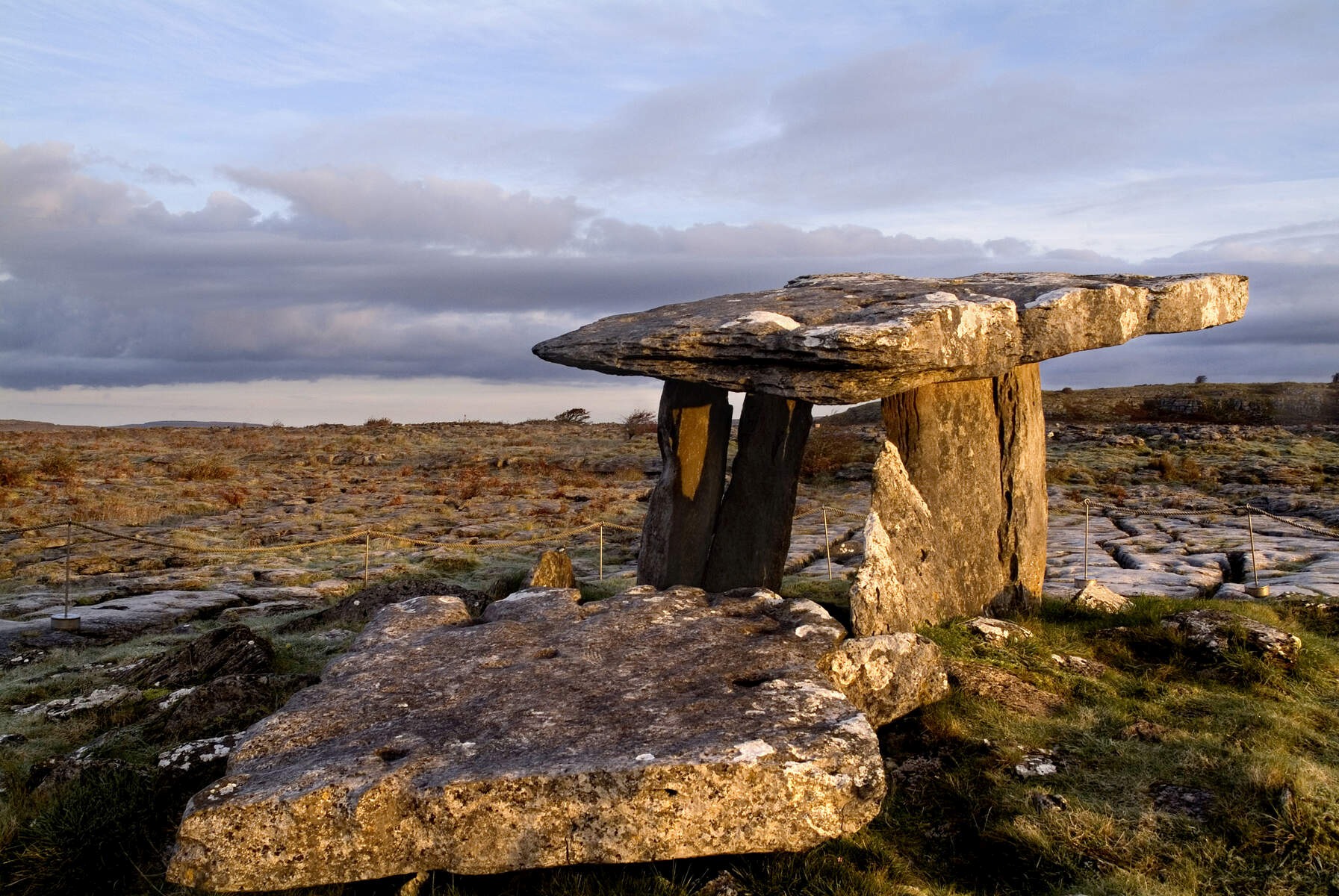
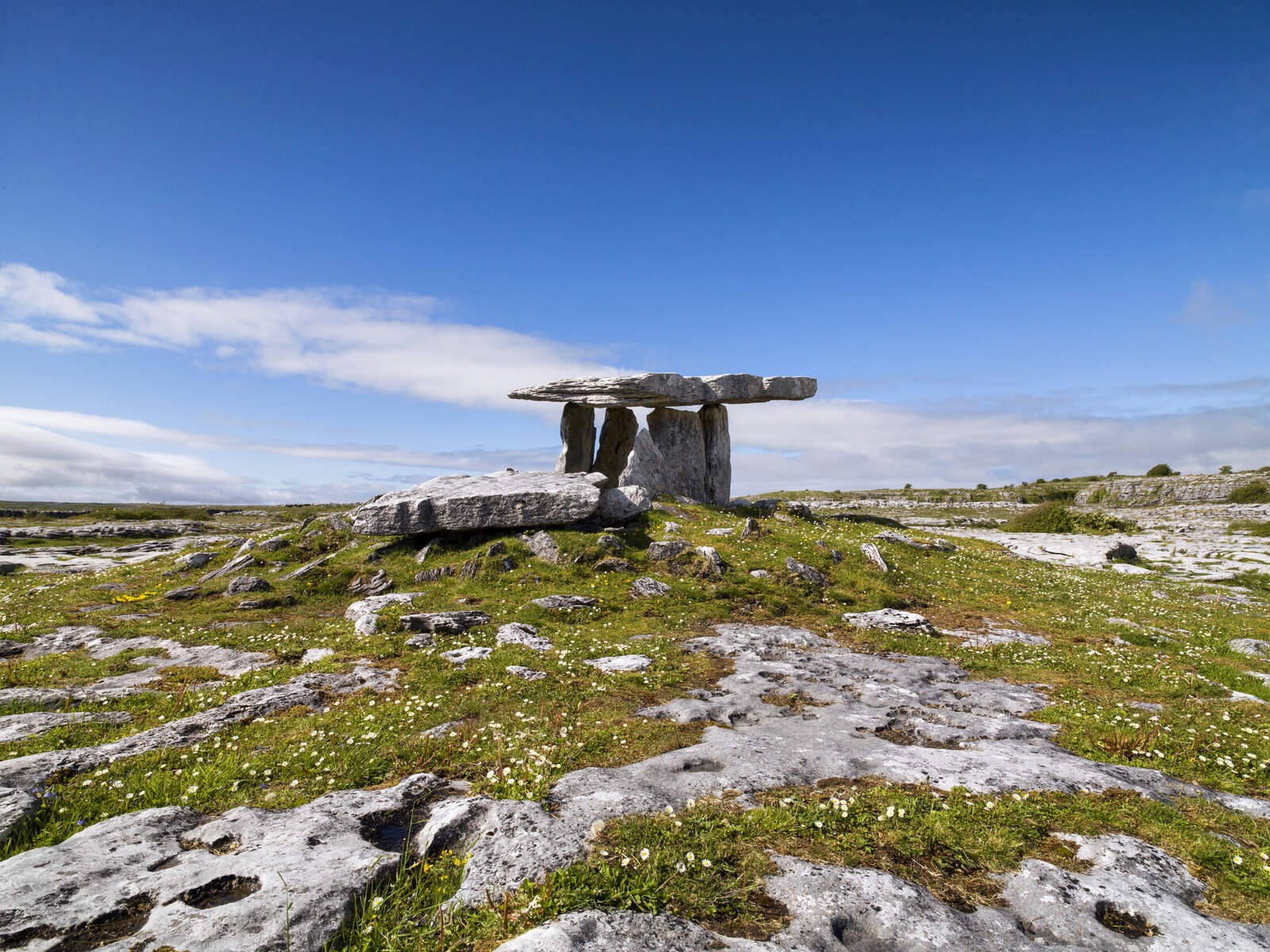
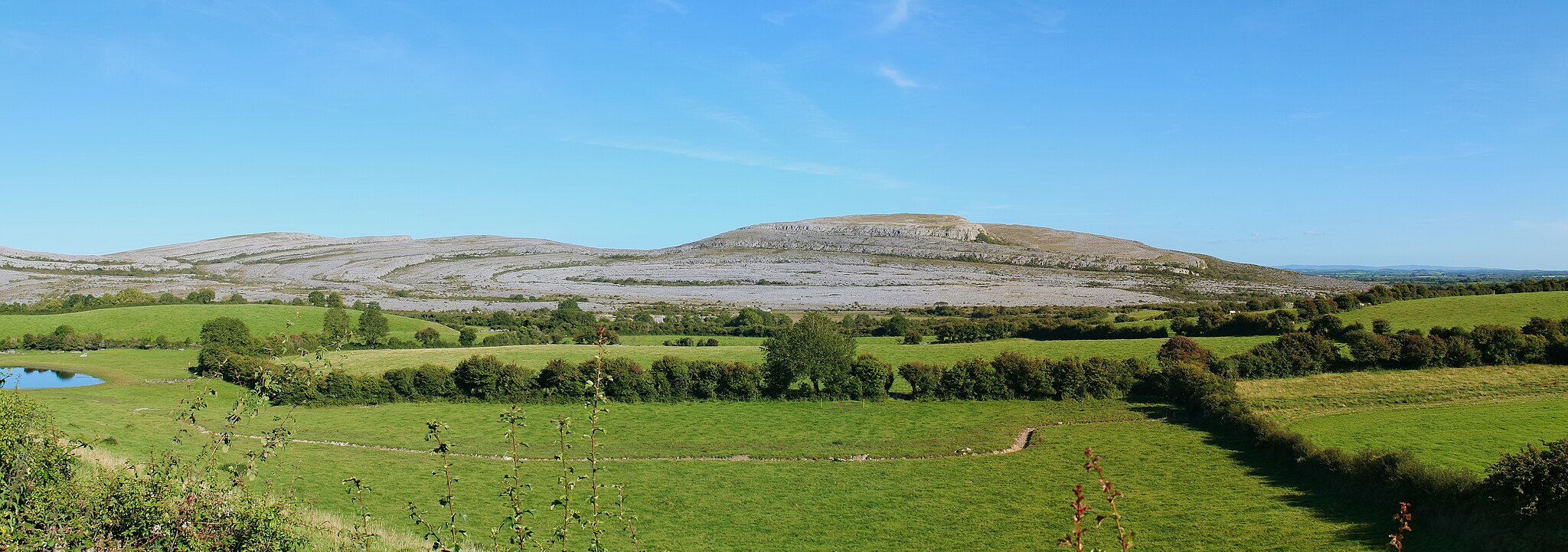
The Poulnabrone Dolmen is Ireland's largest portal tomb. It is located at one of the highest points in the Burren in Co. Clare. It's made up of several large upright stones supporting a nes supporting a large capstone. Another large stone on the ground to the rear of the monument was likely a second capstone which may have covered the back of the structure. The remains of 33 males and females have been found here dating from 3800-3200 BCE. A newborn was also discovered at the monument, however their remains date to the Early Bronze Age between 1750 and 1420 BCE. Poulnabrone is now believed to have been a marker representing the beginning of tribal land during the Neolithic period. The dolmen obviously sits in a transitional space, where lush green farmland gives way to the dissolving limestone bedrock (karst) of the Burren.
Dún Aonghasa
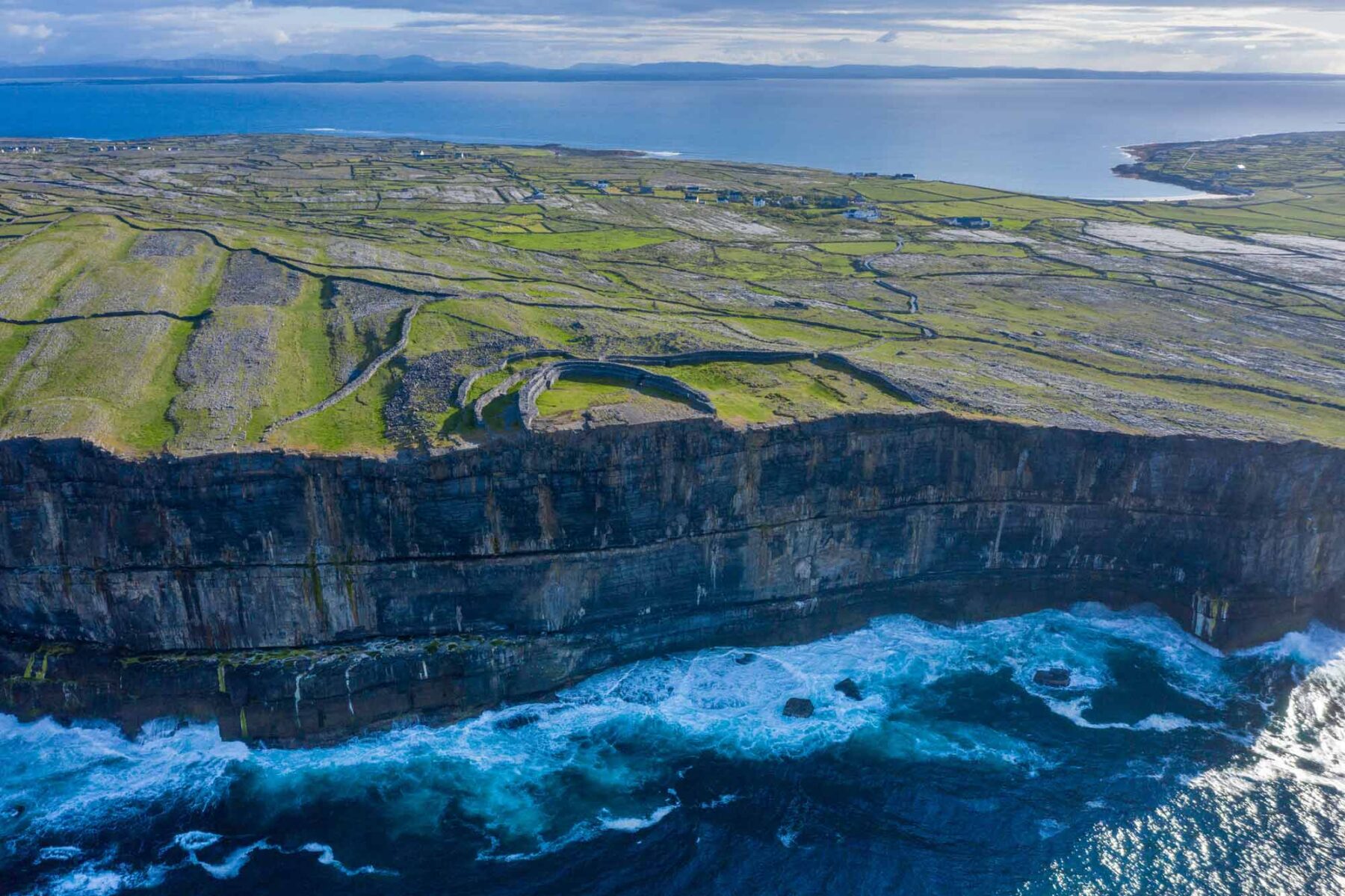
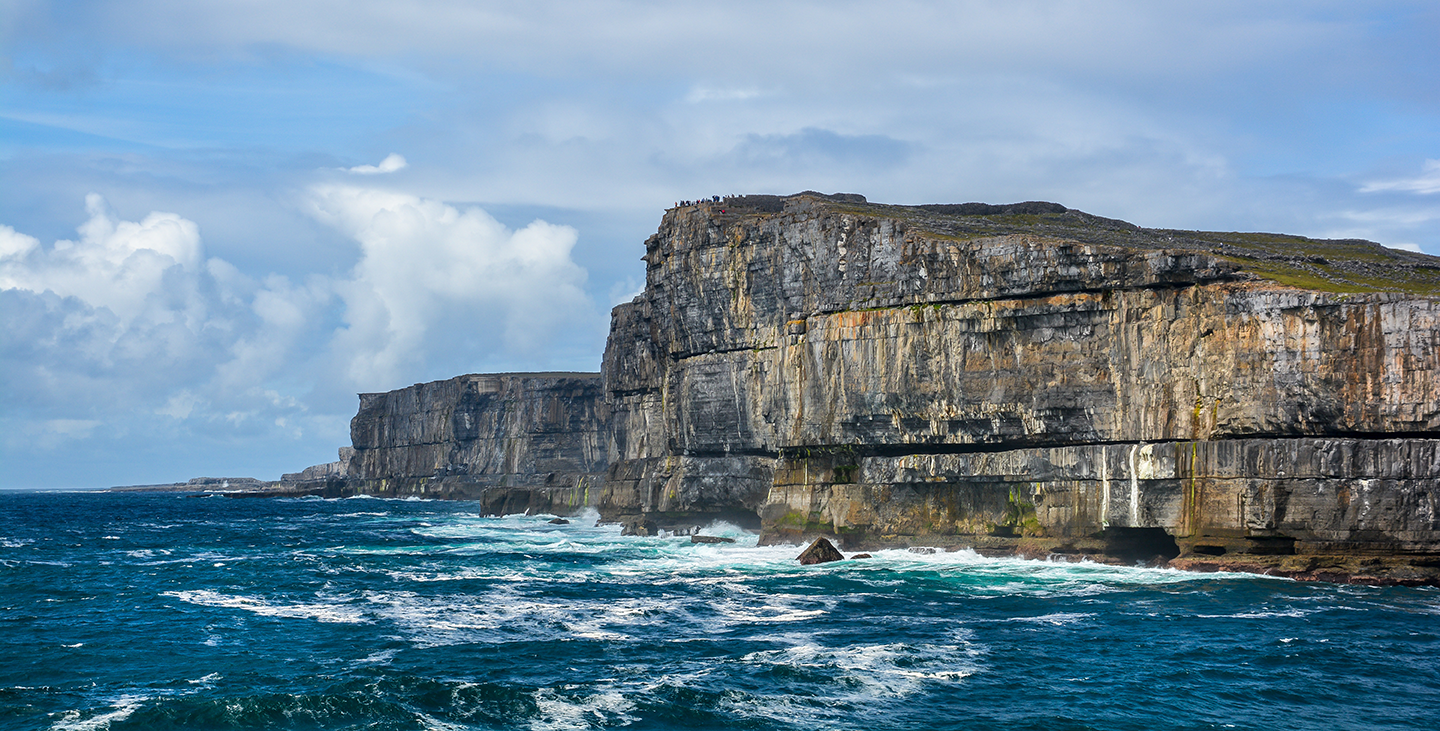
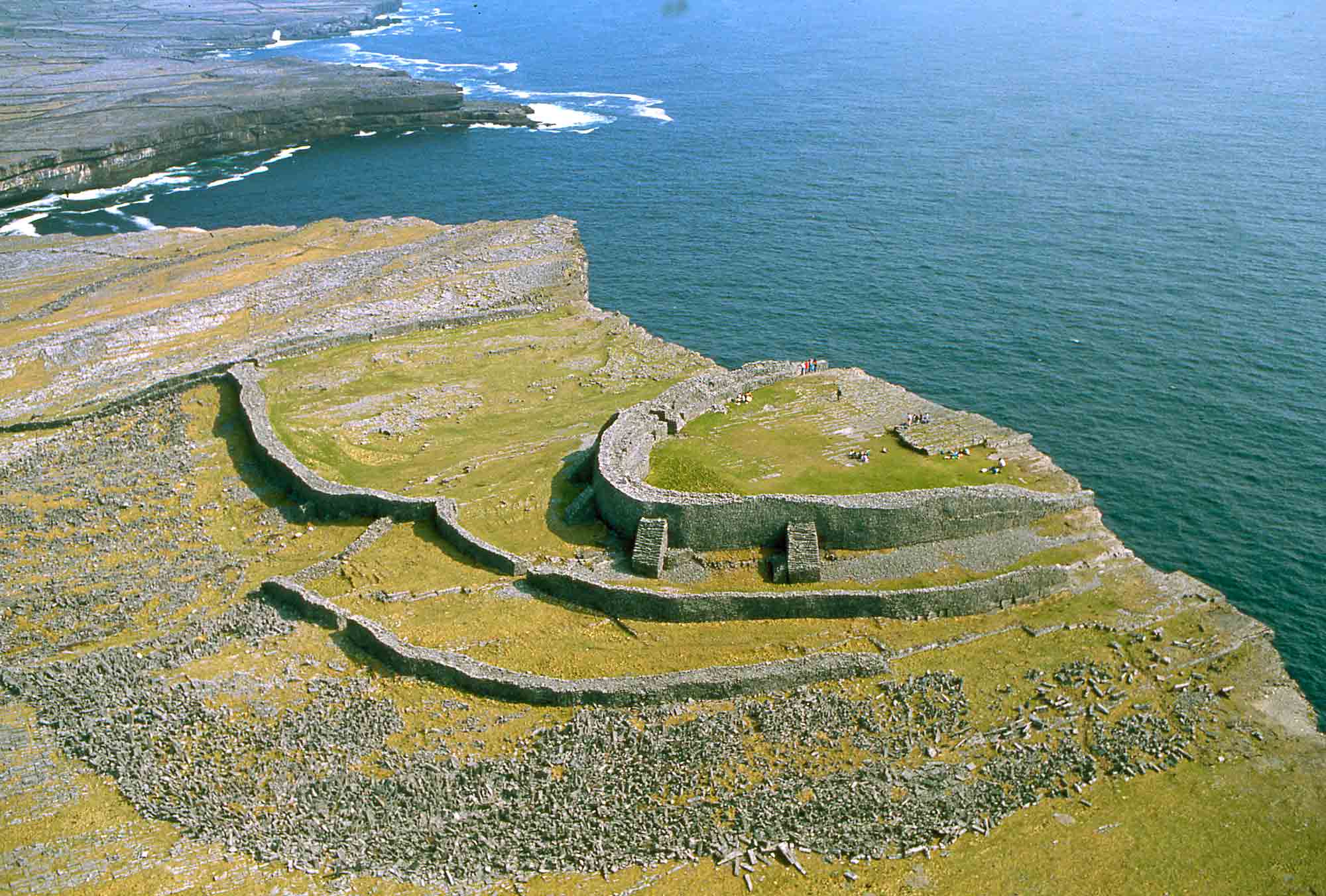
Out on Inis Mór in Galway Bay lies Dún Aonghasa, a Neolithic Stone Fort, built out from a 285-foot sheer cliff over the Atlantic. Its 15-foot walls were placed rock by rock from the limestone landscape that makes up the Aran Islands. Its three defensive walls are surrounded by a chevaux-de-frise—a dense band of about 10,000 jagged upright stones that surrounds the entire fort from cliff to cliff. In typically understated fashion, Heritage Ireland reminds visitors, "Be careful, too, when walking near the cliff – there is no fence or barrier at the edge of the 87-metre drop."
The Passage Tombs
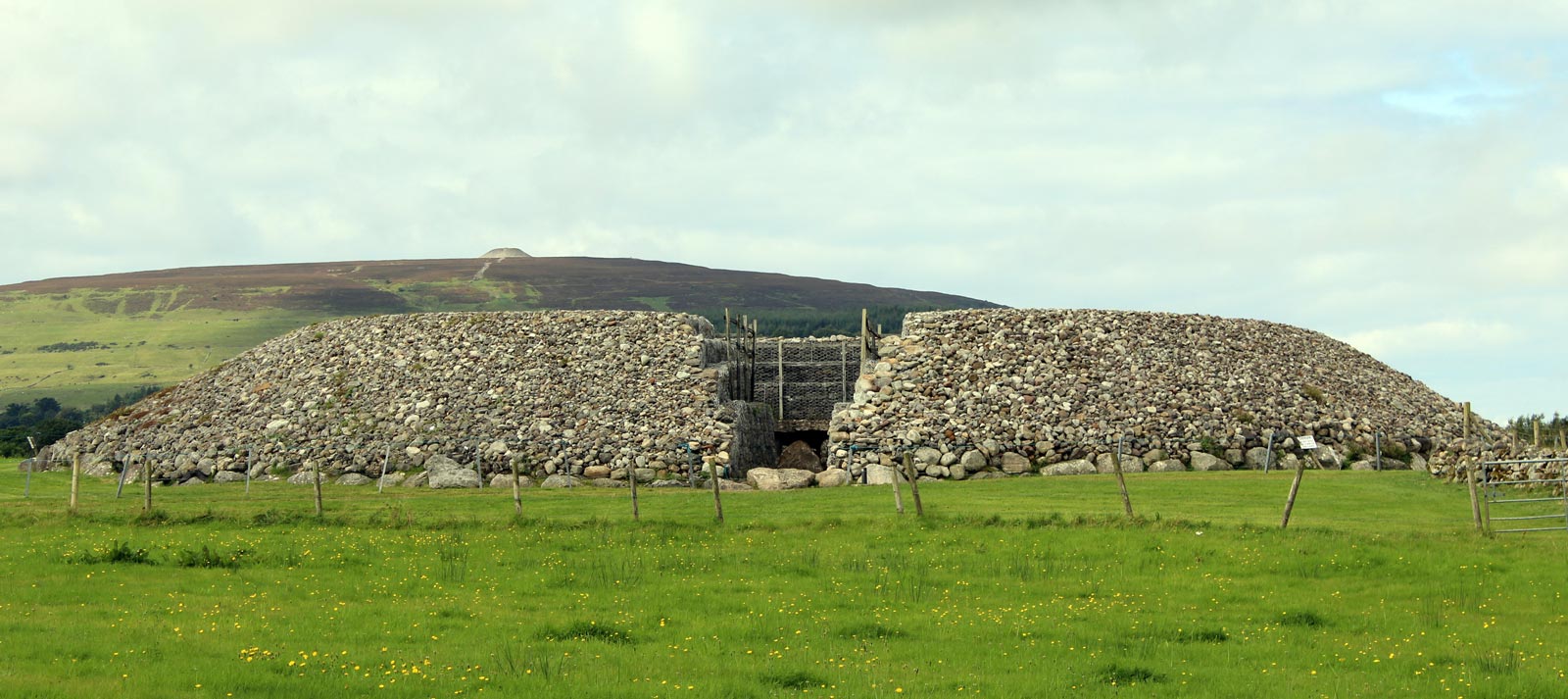
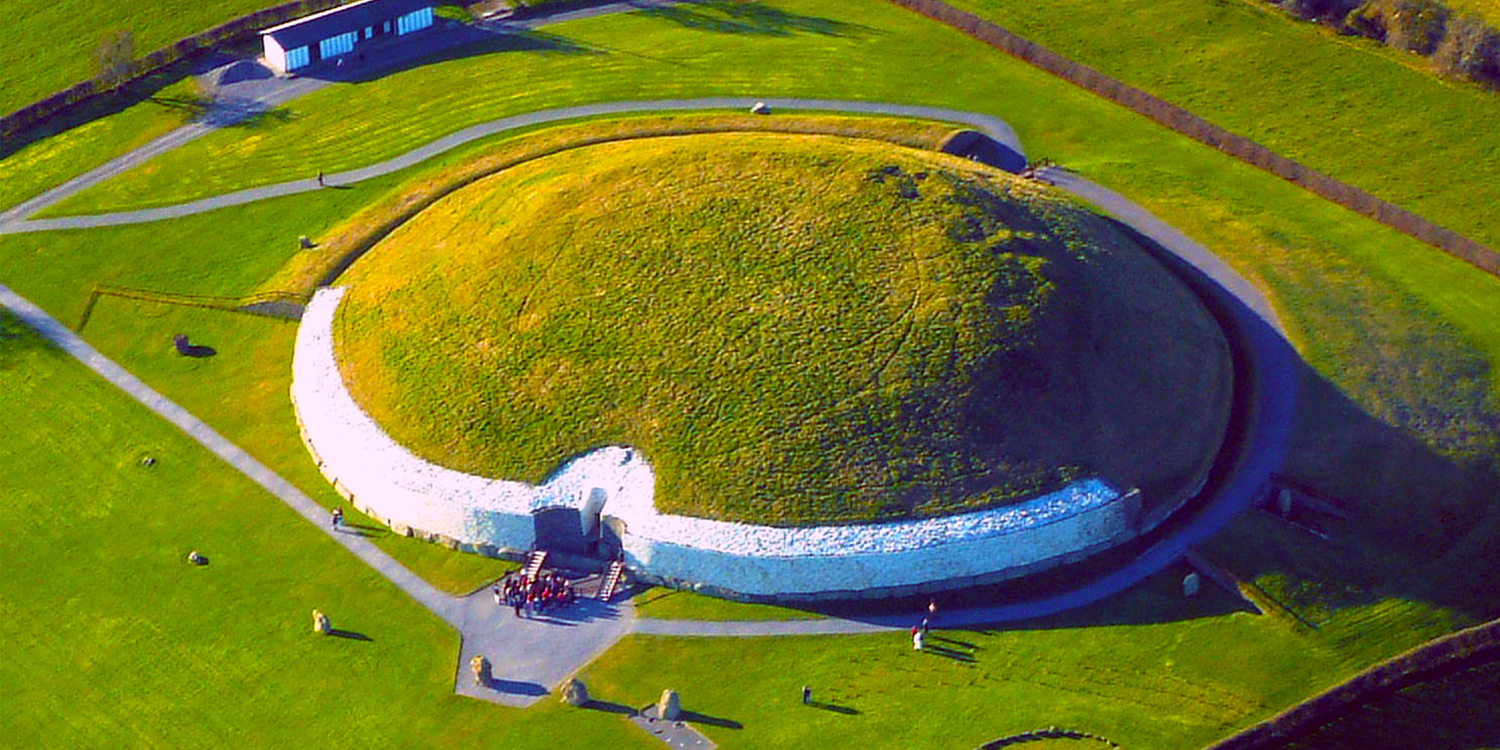
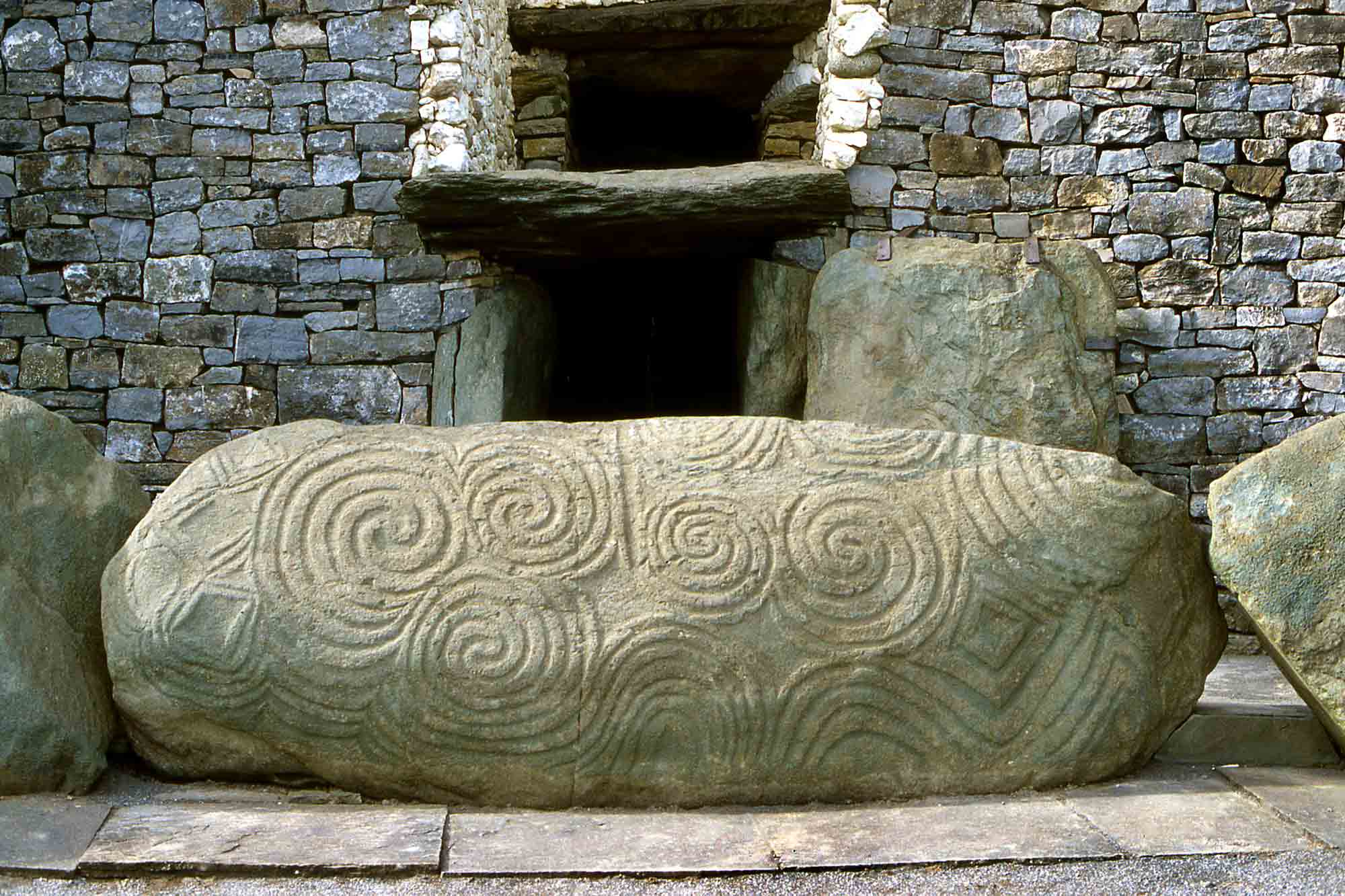
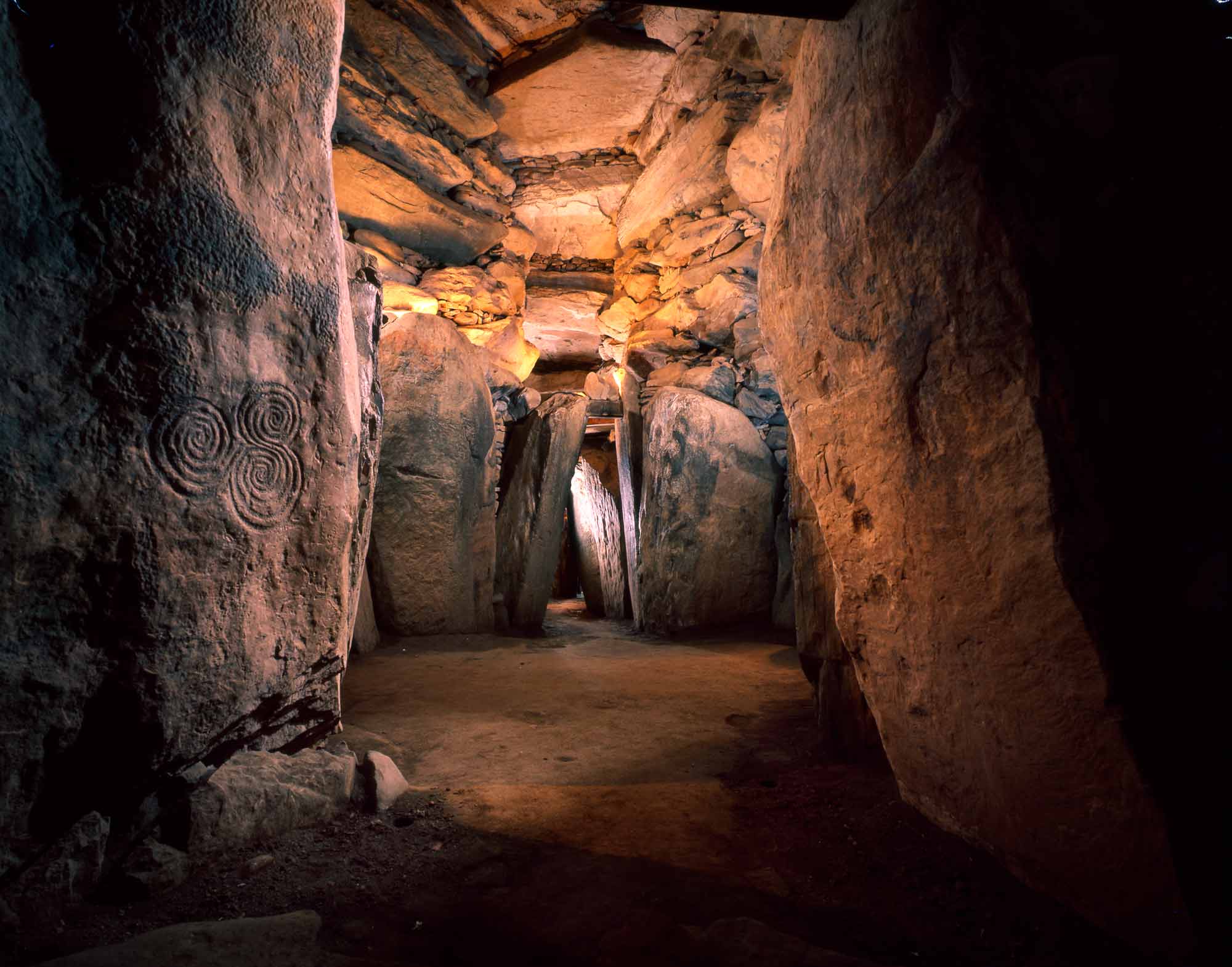
Perhaps the most impressive artifacts from the Neolithic in Ireland are the Passage Tombs. They're usually set in a round mound, on a hilltop, aligned to some solar calendar, and grouped with other tombs. While the tombs at Knowth and Dowth are impressive, the tomb at Newgrange is considered to be the one of the most important Neolithic sites in the world. They're all in the Boyne Valley in Co. Meath. The mound at Newgrange covers amost an acre; it's almost a football field in diameter (279 feet) and over 4 stories tall (43 feet). On the days surrounding the Winter Solstice every year (December 19 to 23), sunlight penetrates a roof opening and completely illuminates its passage and burial chamber. Considering that it was built 500 years before the Great Pyramids at Giza and more than 1,000 years before Stonehenge, its architecture and accuracy are amazing.

Bronze Age settlers (around 2,500 BCE to c. 500 BCE)
have also left evidence of their presence.
The Hill of Tara
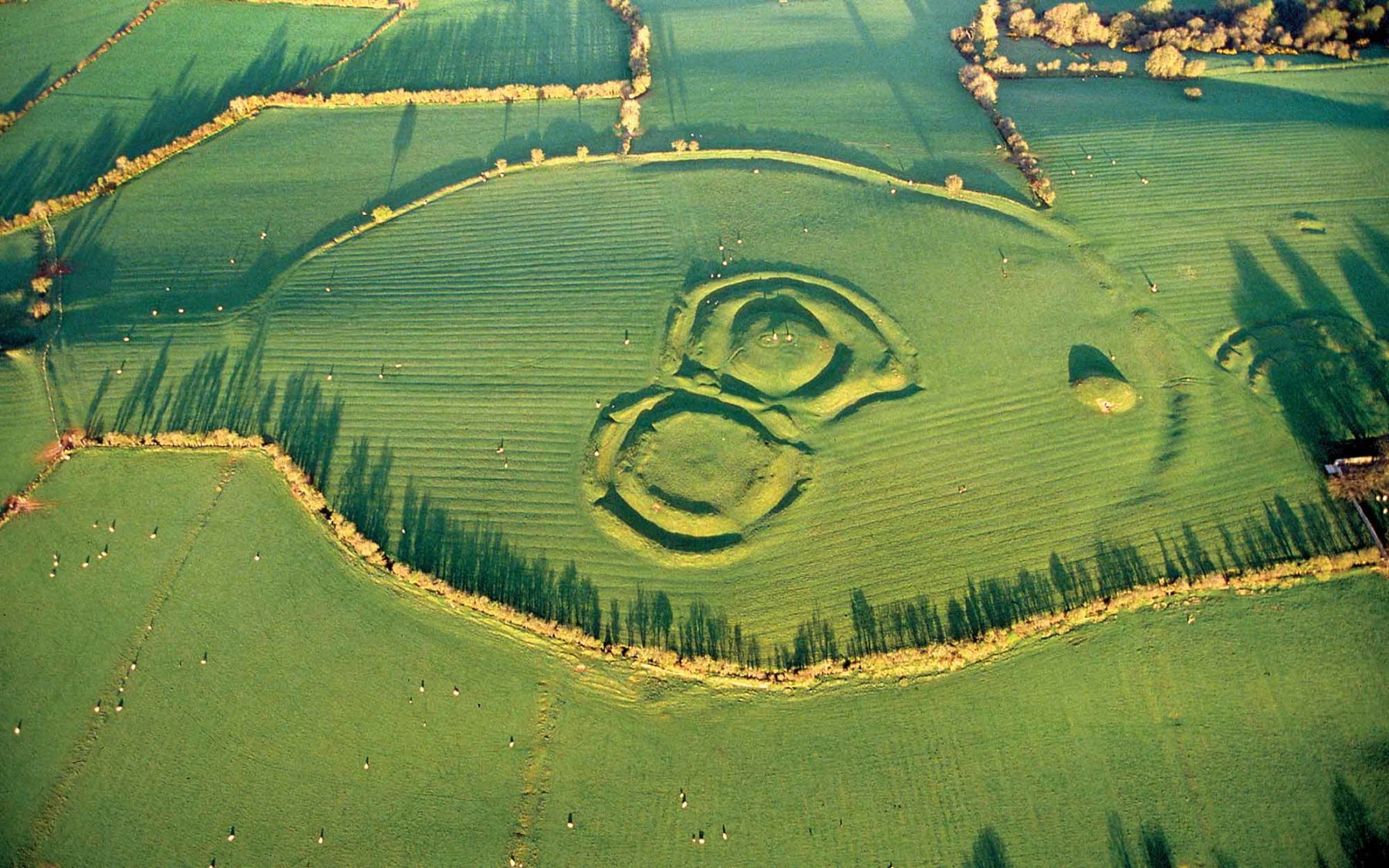
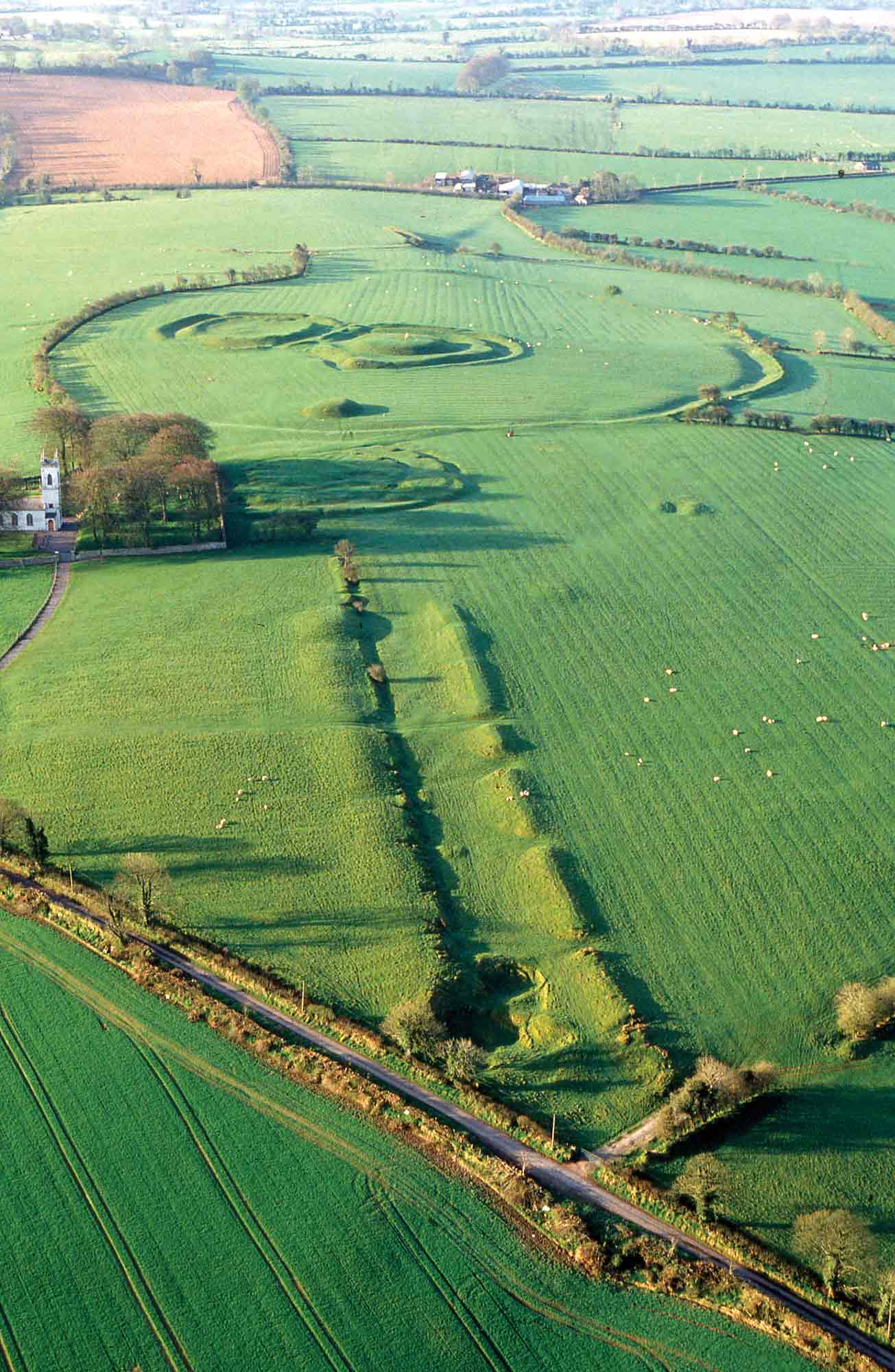
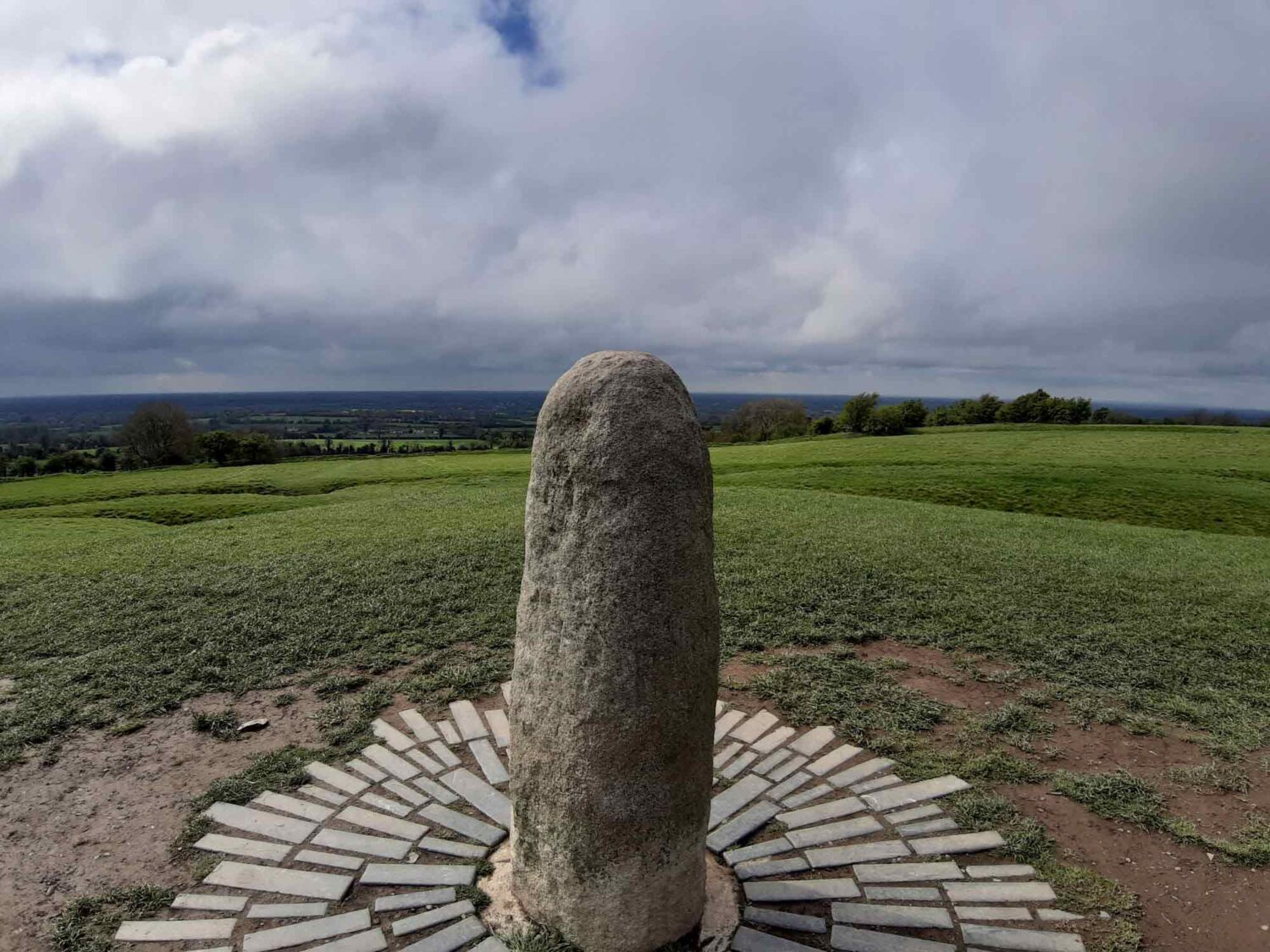
The Hill of Tara was originally the site of a passage tomb, but it eventually became the seat of the high king of Ireland. St Patrick himself went there in the fifth century, and brought Chistianity with him. As the religion spread over the following centuries, Tara’s importance became more symbolic than civic. Its halls and palaces have now disappeared and only earthworks remain, but they give us some idea of the scope of this site.
Once all the oohing and aahing is over . . .
That's where the agreements end on Ireland's prehistory.
The "Peoples" Problem
The traditional view of the pre-historic development of the island relies heavily on two conjectural premises:
- The Lebor Gabála Érenn (The Book of Ireland's Taking or The Book of Invasions), a medieval text, copied out literally thousands of years after the events it purports to recount, and
- The presence of Celtic culture, language and artifacts.
This view posits that there were four separate Celtic invasions/migrations of Ireland:
- The Priteni
- The Belgae
- The Laighin
- The Milesians
That last invasion/migration is considered in two parts: the initial group coming from northern Iberia or southern Gaul, and a later group, the Euerni, from northern Gaul, who began arriving in the 6th century BCE.
However . . .
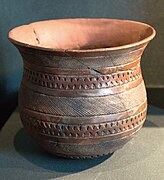
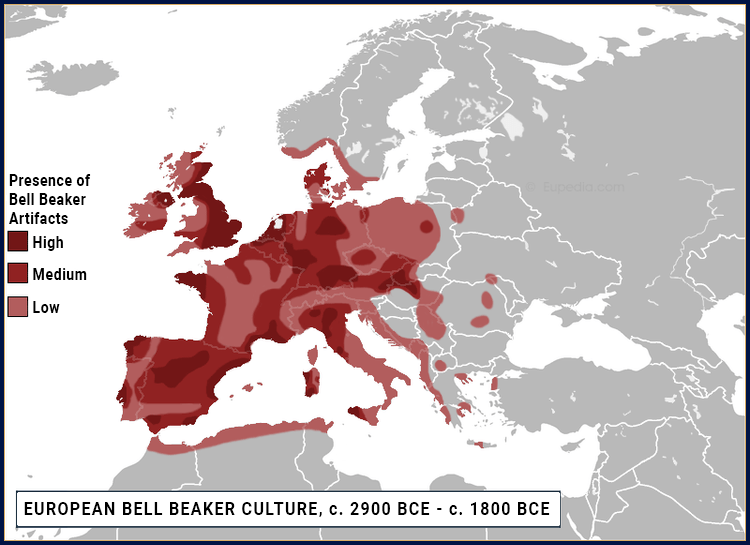
more recent genetic studies, using both chromosome mutations and mitochondrial DNA, have linked the modern Irish to a pan-European culture named for its use of drinking vessels in the shape of an inverted bell. The Bell Beaker culture was dominant in Europe for over 1,000 years. Over 90% of the men in Ireland today have genetic mutations found only in this group. These studies suggest that tribes from all along the "Atlantic Fringe" ended up in the British Isles.
So . . .
while it's convenient to read the myths and sagas we have in the light of the traditional "Four Waves" view, those readings may make sense to us only because we're familiar with them. Are the Firbolgs actually the Priteni? Are the Tuatha de Danaan actually the Belgae? If we follow that tradition to its logical conclusion, then the Milesians are presenting themselves as greater than their own gods.
And it would also be nice to claim Irish exceptionalism, to say that Ireland was the sole land mass in Europe to be unaffected by the Bell Beaker culture, but what little evidence we have suggests that this can't be the case.
A Taste of the Theories
Here's a sampling of the current state of archeological theories about the prehistory of Ireland:
The earliest human evidence in Ireland is mentioned by Michael J. O'Kelly in Early Ireland (U of Cambridge P, 1989, pp. 9-10). Discussing the period 7,600 BCE, he writes: "It is known that man was in Ireland at this time." The settlers that arrived in Ireland and Orkney then belonged to an ocean migration of people with Rh-negative blood types, genetically identical to the Berbers of North Africa and Basques of Europe. Today these dark-featured people are referred to jokingly as the “Black Irish.” The prevailing theory is that this ocean migration is associated with the trade in reindeer hides, used for ship sails in the Mediterranean. The hides were obtained in Arctic Norway, then salted and shipped to Southern Sweden and the west coast of Ireland for oak tanning. This began during a time when the North Sea was still dry land, so ships had to follow a western route. The first settlers were likely support crews for the reindeer hide trade with the Mediterranean, with settlements dedicated to ship repair, resting places, provision of food, etc., not the regular survival clans.
— "Early Migrations to Ireland." Dr. Erich Fred Legner
Compared to the rather simple and restricted migration of the Berbers, the blond Shardana Tribe covered a huge area in Europe and Asia. They are easy to spot because they look quite different from the other tribes, with their blue eyes, fine and straight, straw-colored hair, and tall stature; especially the tallness of the women is notable. Wherever they went they built a reputation for being superb handlers and breeders of domestic animals, mostly horses and cattle. What is rarely mentioned is that they were, and still are, superb sailors and navigators; in fact they were the "Shardana", one of the tribes that the Egyptians called "The Sea Peoples" . . . [The name the Egyptians gave them, "Shardana" translates to, "All of them are good looking".] They are also known for their independence of mind; "if you hire a Friesian, you hire a reliable worker and an argument" is the saying in Canada. They don't seem to be able (or willing) to change that.
The blond people are well known in NE Turkey as the Circaskian Turks, who are considered to be among the best horsemen on earth. The blond peoples' migration to the fertile and safe Ukraine increased their numbers enormously and allowed them to live longer lives. From there they spread over large areas, so that we now call them Ukrainians, White Russians, Lithuanians, Latvians, Danes, Friesians, Vikings and Icelanders. The Friesians are known around the world for their "Friesian cattle," the best milk cows anywhere (often today called Holstein cattle). . . . The unbelievably fertile loess soils of the Ukraine provided abundant and reliable crops and they multiplied there exponentially, so after many centuries of healthy living even the enormous Ukraine became crowded. Academics agree that the blond tribe fanned out to northern and western Europe. Similar migrations took place from the Caucasus but archaeologists also tell us that they cannot have been in the Caucasus or the Ukraine for more than 8,000 years. So where did they come from if they were not Caucasians? There was another population of blond people, located on the north east coast of Libya in North Africa, especially in Cyrenaica, which is wedged between Libya and Egypt. Nyland (2001) suggested that this could be the place where the original blond mutation originated. However, Fell’s (1982) idea that they rather descended from Norsemen immigrants around the time of the Sea Peoples' invasions is also a plausible explanation.
— "The Sea Peoples." Dr. Erich Fred Legner
Irish traditions amply confirm the evidence of Greek writers that Ireland was once a country of the Pretani, Cruithin, or Picts. Our own writers, in the seventh century and later, show that in their time there were numerous families, including many of high degree, in every quarter of Ireland but especially in Ulster and Connacht, who were recognised to be of Pictish descent. The problem ‘Who were the Picts?’ has long been under discussion. Ancient and firm tradition, in Britain as well as in Ireland, declared them to be quite a distinct people from the Gaels and the Britons; and some who have sought to solve the problem have ignored the existence of a large Pictish element in Ireland. The view of the late Sir John Rhys appears most reasonable, that, whereas the Celts came from Mid-Europe and belonged to the ‘Indo-European’ linguistic group, the Picts belong to the older peoples of Western Europe. They were the chief people of Ireland in the Bronze Age, and to them the Irish arts and crafts and monuments of that age may be ascribed.
. . . Nowadays there is a growing acceptance that our predominant genetic heritage is not “Celtic” at all but can be traced back to the Neolithic period and before, with archæologist Peter Woodman concluding: “The Irish are essentially pre-Indo-European, they are not physically Celtic.” And of the pre-Celtic inhabitants of the North of Ireland, historian Francis Byrne has pointed out that, following the “Uí Néill” invasions into Ulster, “the bulk of the population in the reduced over-kingdom of Ulaid were the people known as Cruthin or Cruithni.”
— "The Academic Suppression of the History of the Native British or Cruthin, the People of the Pretani.” Dr. Ian Adamson, OBE.
So . . .
Was prehistoric Ireland Celtic or not?
Were the Picts the first migrants to the island?
Were the original settlers from North Africa?
Are these people I'm quoting above representative of the main stream of archeological thought, or have I stumbled onto a couple of fringe thinkers?
I have so little knowledge in this area that it's impossible for me to judge the quality of the evidence they're presenting, so I can't pick a side, or even weigh in on these debates with any sense of authority.
All I can say for certain is that getting this right is a big problem.
The "Literature" Problem
I have to admit, this isn't really as big a problem as the archeological one above, but it's more germane to our field of study, and has deeper implications for our consideration of the earliests texts we have in Old Irish.
As should be obvious, the "literature" of this era was entirely oral, but considering the material of this period as "oral literature" is a bit of a problem. The term literature is taken from the Latin littera, “letter,” which is fundamentally tied to the use of letters in writing. Some scholars have suggested that terms like "oral genres" or "standardized oral forms" would make more sense. In Ireland this material was passed down through any number of generations by passed down through generations by filí ("poets") and bards. These living "texts" varied from teller to teller, and were not codified or regularized in any sense until they were first written down.
Walter Ong, SJ (we called him "Jolly Wally" behind his back, because he was anything but) is probably the preeminent theorist on this topic. His rightly famous Orality and Literacy: The Technologizing of the World argues that writing, and the development of print culture, didn't just arise out of nothing. It came from a rich and well-developed oral culture. Speech itself ("orality," to use his term) is more fundamental than writing; orality precedes and underpins literacy. An oral culture treats words with a level of respect that literate cultures have the luxury to neglect. A printed text is stored between the covers of some leaves of vellum, or papyrus, or paper; an oral, memorized text is stored in the souls of the members of that society. Orality creates communities, because speech always involves more than one person. Literacy can't do that; reading is almost always a solitary activity. Group hearing unites, but individual reading, though beneficial, can have the opposite effect. Two people may be reading the same text, but this doesn't mean they're having the same experience of it.
Literacy, he argues, has fundamentally altered human thought processes, memory, and perception. Writing restructures consciousness,and the widespread adoption of the technology of writing has significant effects on the cognitive processes, social structures, and cultural characteristics of a society. Literacy frees us, intellectually, from reliance on formulas or conventions. Writing something down means we don't need to spend intellectual energy on remembering or memorizing a text. The words themselves carry that mnemonic burden of remembrance, and allow readers to spend their intellectual enegy on greater analytical thought and innovation.
In oral cultures, a narrative is a way to store and transmit information. These narratives aren't primitive, but they are populated with character types, and are structured as series of episodes. Both of these help with knowledge retention and ease of recollection. In literate cultures, narratives can develop with a greater focus on introspection, more complex characters, and structures that work to a climax and resolution.
Literacy is imperious. It tends to arrogate to itself supreme power by taking itself as normative for human expression and thought. This is particularly true in high-technology cultures, which are built on literacy of necessity and which encourage the impression that literacy is an always to be expected and even natural state of affairs.
Since we can't explore the origins of these earliest narratives, even though we're looking at some of the first written texts, we're really beginning out sutdy in media res.
We're left with . . .
only inferences, not evidence. We can only infer that these stories laid down the foundational myths, heroic tales, and societal knowledge that would later be recorded and preserved.
Characteristics
There are some common elements associated with the oral transmission of culture that we can safely say applied to Ireland, because we've seen them in other cultures across the world that made the transition from orality to literacy.
Transmitters used highly stylized language with recognizable conventions.
Transmitters used alliteration and assonance as mnemonic devices.
Transmitters used complex metrical forms, with little or no distinction between poetry and prose.
Genres
Heroic Sagas
Tales of warriors, kings, and their exploits, often centered around tribal conflicts and cattle raids. The seeds of what would become the Ulster Cycle were sown here.
Mythological Tales
Stories of gods, goddesses, and supernatural beings, explaining the origins of the world, natural phenomena, and the Irish people.
Genealogies and King Lists
Important for establishing lineage, social status, and rights to land and kingship.
Praise Poetry and Laments
Compositions honoring patrons or mourning the dead.
Wisdom Literature and Triads
Sayings, proverbs, and categorized knowledge.
Evidence
While no written texts survive directly from this period, the themes, characters, and stylistic features were preserved and written down by later Christian scribes (who certainly sought to bend these stories to their own world view) in collections such as the Lebor Gabála Érenn. Archaeological evidence also provides context.
The "Secret" Celts
The people of pre-Christian Ireland certainly had their own customs, beliefs, and histories. But none of it was written down for hundreds, or maybe thousands, of years. These cultural touchstones were all passed on through poems, songs, and stories. By its very nature, this oral tradition could not be widely disseminated; there were no manuscripts, no forms of writing that would allow broad distribution and cultural assimilation. Individual story-tellers created nuanced versions of the tales they memorized and repeated, so there was not even an agreed-upon corpus of works within this tradition. This hiddenness, or insularity, was so fundamental to the communication of knowledge, not just on this island, but throughout Europe at the time, that it even lent its name to the culture itself: "Celt," or "hidden." The Celts were the people who kept their history hidden, because they didn't write it down. In modern Irish, the term "faoi ceilt" still means "concealed" "furtive," "shrouded," or "secret" today.
The Seanchaithe
In ancient Celtic society, the seanchaithe ("bearers of old lore"; singular: seanchaí) were servants to the heads of the lineages, chieftains, and kings, and were held in high esteem. They were the repositories of important information for the clan or tribe: laws, genealogies, annals, literature, etc. Their poems and songs were the only historical record available until the advdent of the ogham script. After English colonization destroyed the Gaelic civilization in the 17th century, these more formal roles ceased to exist, and the term seanchaí came to be associated instead with traditional storytellers from the lower classes. In their original positions, the seanchaithe were an important link in Celtic/Irish cultural heritage. Even today, in their lesser form, they play a dominant role in preserving and reconstituing the Irish oral tradition. They are especially associated with the Gaeltacht (the Irish-speaking areas of Ireland).
Celtic scholars do not doubt that there was an active oral narrative tradition functioning in pre-Christian and medieval Christian Irish society. Until recently, tradition-bearers with amazingly large story-repertoires could be found among Gaelic-speaking peasants and fishermen in Ireland and Scotland. These creative oral artists, often neglected and no longer listened to in their own time, bore vivid testimony to a long-lived and rich Gaelic tradition of stories and narrative techniques—a tradition that is often referred to in the extant corpus of medieval Irish literature, from its earliest stages (the sixth to ninth centuries A.D.) to the beginnings of the modern literary era (the seventeenth and eighteenth centuries). Although the documented contemporary sgéalí, “storyteller” (scélaige in earlier Irish spelling), is an amateur—that is, he is not paid for his performance, nor does he live by his storytelling craft—the medieval narrator usually was a professional, and in fact was often a member of the exalted sodality of professional poets known as the filid (singular fili, from a root meaning “to see”), who together with musicians and other possessors of special technical knowledge constituted the wider class of the áes dána, “people of art[s],” or (áes cerda, “people of craft[s].” While the fili’s main activity was the composition of verse celebrating his patrons and detailing the genealogy and lore of families and tribes, we are told in a medieval Irish tract on the training of filid that the oral transmission and performance of traditional prose tales—scéla, sing. scél, from a root meaning “to say” (Greene 1954:26)—was an essential aspect of filidecht, “the poetic profession.”
— Joseph Falaky Nagy. "Orality in Medieval Irish Narrative: An Overview." Oral Tradition, vol. 1, no. 2 (1986), pp. 272-301.
* These guides use five special symbols, taken from Mark Williams' Ireland’s Immortals: A History of the Gods of Irish Myth, Princeton UP, 2016.
ə |
the uh sound at the end of sofa |
|
a throaty gh sound, similar to the -ch in Scots loch but further back and down in the gullet. Not to be confused with the letter "y" |
kh |
the ch in Scots loch, spelled with a k– to avoid confusion with the ch in English child. |
ð |
the th– sound at the start of those, that, and than, which is different from the th– sound at the beginning of thick, thin, or think. |
ʸ |
indicates that the preceding consonant is "palatal," that is, accompanied by a y-glide like the m in mew or the c in cute (contrast moo and coot). This often occurs at the end of a word: in a form like the place-name Crúachain, which would be KROO-əkh-ənʸ. The y is there simply to indicate that the final consonant is pronounced like the first n in onion; it does not add a syllable. |