TIMELINE OF IRISH LITERATURE
from 600 BCE to 1850 CE
EARLY CHRISTIAN / OLD IRISH PERIOD — c. 431 CE - c. 900 CE
SHEN-khəs MAHR
Amra Coluimb Chille
AM-rah COH-lume KIll ə
an Rúraíocht
AHN ROO-ree-ukht
an Fhiannaíocht
AHN EE-un-ee-ukht
Cú Chulainn
KOO KHULL-ənn (KHULL rhymes with "skull")
Conchobar mac Nessa
KON-khəv-ər mack NESS-ə
Táin Bó Cúailnge
TOINʸ BOW (as in "bow and arrow") KOOL-ngʸə
Longes mac n-Uislenn
LONG-ess mack NISH-lenn
Túatha Dé Danann
TOO-əth-ə DAY DA-nənn
Cath Maige Tuired
KATH MAɣə TOO-rəð
Tochmarc Étaíne
TOKH-vərk AY-deen-yə
Lebor na hUidre
LʸOWER (rhymes with "flower") nə HIR-ə
Teamhair na Rí
CHOW-her nah REE
Dinnsenchas
din-SHEN-khəss
faithche
FAY-ðə
Context
Irish literature holds a place of particular prominence among the various national literatures of Europe. As that most fundamental of references, Encyclopaedia Britannica, has it,
After the literatures of Greek and Latin, literature in Irish is the oldest literature in Europe, dating from the 4th or 5th century CE. The presence of a “dual tradition” in Irish writing has been important in shaping and inflecting the material written in English, the language of Ireland’s colonizers. Irish writing is, despite its unique national and linguistic characteristics, inevitably intertwined with English literature, and this relationship has led frequently to the absorption of Irish writers and texts into the canon of English literature
The arrival of Christianity in Ireland (traditionally dated to St. Patrick in 431 CE) brought with it the Latin alphabet and the practice of manuscript writing. Monasteries became crucial centers for learning, preserving oral traditions in written form, and developing new genres of Irish literature. In their scriptoria monks transcribed and preseerved both the native oral traditions and classical/Christian learning.
Language
Old Irish is the earliest form of the Gaelic languages for which significant written texts survive.
Key Developments & Genres
Ogham Inscriptions (c. 4th-7th centuries)
The earliest form of writing in Irish, using the Irish Ogham alphabet, which was a system of notches and horizontal or diagonal lines/scores to represent the sounds of an early form of the Irish language. Roughly 400 inscriptions in the Irish Ogham alphabet are known from stone monuments scattered around the Irish Sea, the bulk of them dating to the 5th and 6th centuries. The language of these inscriptions is predominantly Old Irish, but a few examples are fragments of the Pictish language. Ogham itself is an Early Medieval form of alphabet or cipher, sometimes also known as the "Celtic Tree Alphabet." Most of these inscriptions were personal names and boundary markers.
Glosses (from the 7th century)
Irish words and phrases written in the margins or between the lines of Latin texts (especially biblical and grammatical works) to explain or translate. These are invaluable for understanding Old Irish.
Short Lyric Poems
Often personal, religious, or nature-themed, sometimes found as marginalia in manuscripts. "Pangur Bán" is a famous example.
Legal Texts (Brehon Laws)
Extensive tracts detailing customary law, providing insights into early Irish society. The largest collection, Senchas Már (The Great Ancient Tradition), was compiled in the 8th century.
Annals
Chronological records of significant events, initially kept in monasteries (e.g., Annals of Ulster & Annals of Inisfallen) began in this period, though they were compiled over centuries.
Religious literature
Hymns, prayers, biblical translations/adaptations, and lives of saints (hagiography). "Amra Coluimb Chille" ("Elegy for St. Columba") is an early example.
The Cycles
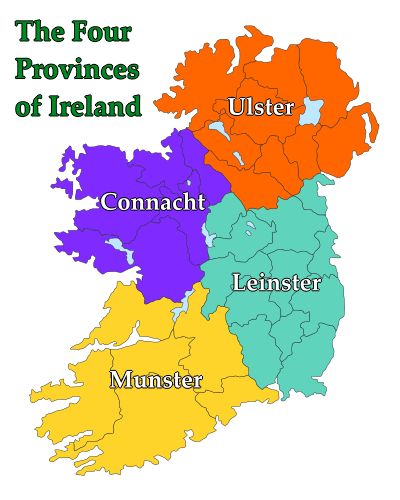
The Ulster Cycle is essentially a collection of stories about border wars.
There are four main "cycles" of stories in Early Irish literature. A "cycle" is usually considered to be a group of prose or poetic narratives, with multiple (or unknown) authors, that centers on the lives and exploits of one or more heroic figures. These groups used to be called "saga cycles," but the term "saga" is more properly applied to medieval Icelandic literature, where it refers to any type of story in prose.
The Ulster Cycle (an Rúraíocht):
The most prominent of all the cycles, the stories of the Ulaid (the people of Ulster) are considered to be the most "literary" of all the cycles. The stories in this cycle take place in the legendary past, and revolve around the mythical heroes of Ulster, especially the warrior Cú Chulainn and King Conchobar mac Nessa and his court. Their conflict with the Connachta and Queen Mebd is a particular focus.
Elements from these stories of the Ulaid were woven together to create the closest thing that Irish literature has to an epic, the Táin Bó Cúailnge (The Cattle Raid of Cooley). It was first put together in the 7th or 8th century CE, and is accalimed for its lively and forceful prose. Many readers claim that its finest section is one where Fergus, who has been exiled from Ulster, remembers the heroic deeds Cú Chulainn performed when he was just a boy. Literary scholars look at the various versions of the tale, as it was worked and reworked over centuries, and see the slow decay of the Old Irish style.
The Fenian Cycle (an Fhiannaíocht):
This collection of stories focuses on the exploits of the mythical hero Fionn mac Cumhaill and his warrior band, the Fianna Éireann. They were a group of highly skilled warriors, huntsmen, and poets. The Fianna flourished under the reign of Cormac mac Airt in the 3rd century CE. It is also called the Ossianic Cycle after its narrator, Oisín. Beyond Fionn and Oisín, the cycle contains stories about other famous Fianna members, including Diarmuid, Caílte, Oisín's son Oscar, and Fionn's rival Goll mac Morna.
The Fenian stories didn't get careful literary treatment like those in the Ulster cycle did; their original forms quickly gave way to prose tales and ballads. So while the Ulster Cycle may have been the beginning of professional literature in Irish, the Fenian cycle can be seen as the beginning of popular literature in Irish.
The Cycles of the Kings, or Kings' Cycles (aka the Historical Cycle):
This cycle is made up of legends about historical and semi-historical kings of Ireland, stories about the origins of dynasties and peoples, accounts of significant battles and small anecdotes that explain the origins of rites and customs. The kings that are included range from the almost entirely fictional Labraid Loingsech, who allegedly became High King in the 4th century BCE, to the entirely historical Brian Boru. It was part of the duty of the medieval Irish bards, or court poets, to record the history of the family and the genealogy of the king they served, which they did in these works, blending myth and history in vary proportions.
One of the most famous legends is the Buile Shuibhne ("The Madness of King Suibhne"), a 12th-century tale told in verse and prose. Suibhne, King of Dál nAraidi, kicked St. Ronan Finn off of his land, and threw his psalter into a pond. The saint cursed him, and he became a kind of half-man, half-bird being who feared humans. His fear meant that he could not settle down, and so he flew(?) around Ireland for seven years, condemned to live out his life in the woods, without human company. This story, like the poem "Pangur Ban," has inspired Irish poets for generations.
The Cycle of the Gods (Scéla Túaithe Dé Danann):
Stories and poems about the Tuatha Dé Danann (who align closely with Ireland's pre-Christian deities) and other mythical races that inhabited the island, such as the Fomorians and the Fir Bolg. Important works in the cycle are the Lebor Gabála Érenn ("Book of Invasions" or "Book of Ireland's Takings"), the Cath Maige Tuired ("Battle of Moytura"), the Aided Chlainne Lirv ("Children of Lir") and Tochmarc Étaínev ("The Wooing of Étaín"). This cycle used to be called the "Mythological Cycle," but that title has fallen out of favor, because the cycle contains only a small part of of the corpus of Irish mythology.

Ogham Inscriptions and Stones
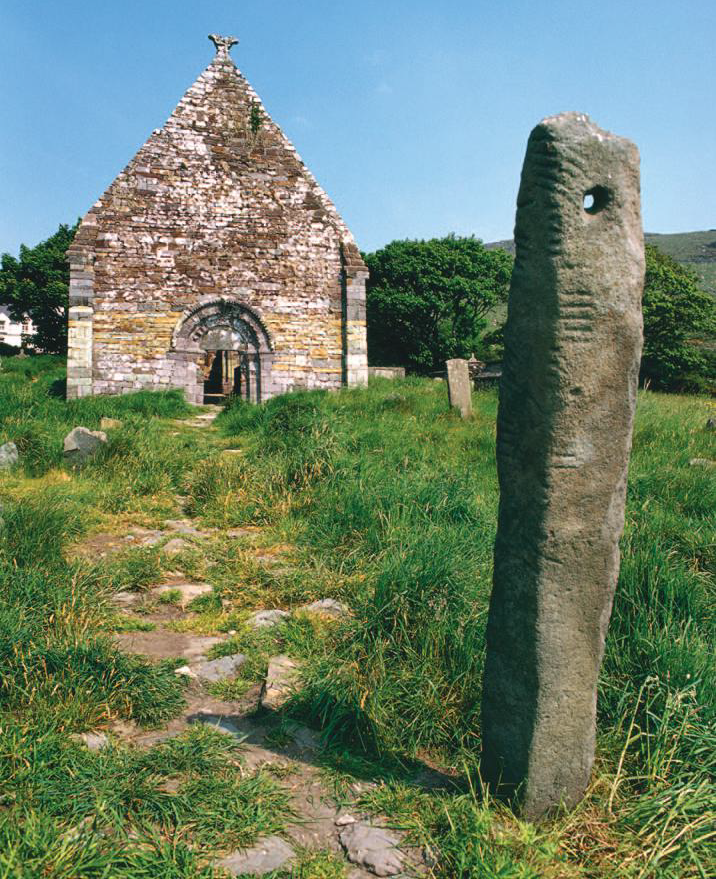
Before people in Ireland starting writing in manuscripts made of vellum they wrote on other materials, primarily stone, in a unique writing system, ogham. This writing system or script was created for an early form of the Irish language; the earliest ogham inscriptions on stone are approximately dated on linguistic grounds to between the 4th and the 7th century CE. Over 400 known examples of ogham stones and fragments of various shapes and sizes have survived, each with its own unique biography or story. While we do not know definitively the purposes to which these tones were put to use, we can make some educated guesses.
Stones as Memorials
Of these roughly 400 Ogham inscriptions, a significant number highlight personal and familial identities. Individuals may have commissioned these stones to immortalize their lineage or status, or to serve as a memorial for one of their ancestors. These inscriptions typically include the name of the individual along with a patronym, which indicates their ancestry. However, Nora White contends that, "[p]ossible associations between the commemorative function of Ogham stones and actual burials, and how these may have changed over time or geographical area, is an ongoing area of study." That's academic speech for "we're not really sure, but it could be this."
Stones as Markers
The Ogham stones also served as boundary markers, or indicators of land ownership. Inscriptions often delineate the boundaries of owned land, speaking of territorial claims. These functioned as legal documents, etched in stone, that proclaimed ownership and, by extension, one’s social standing within the community.
These inscriptions constitute the earliest recorded form of Irish. because of them we have some idea of what the Irish language looked like centuries before people started to write in manuscripts in Latin and Irish using the Latin insular script.
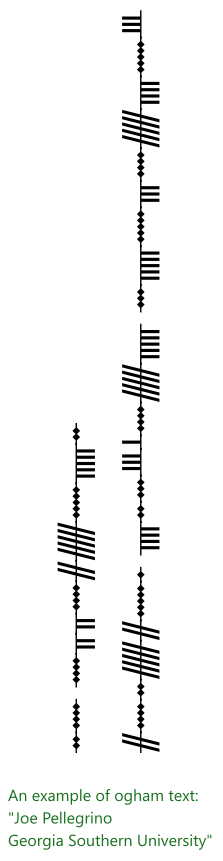
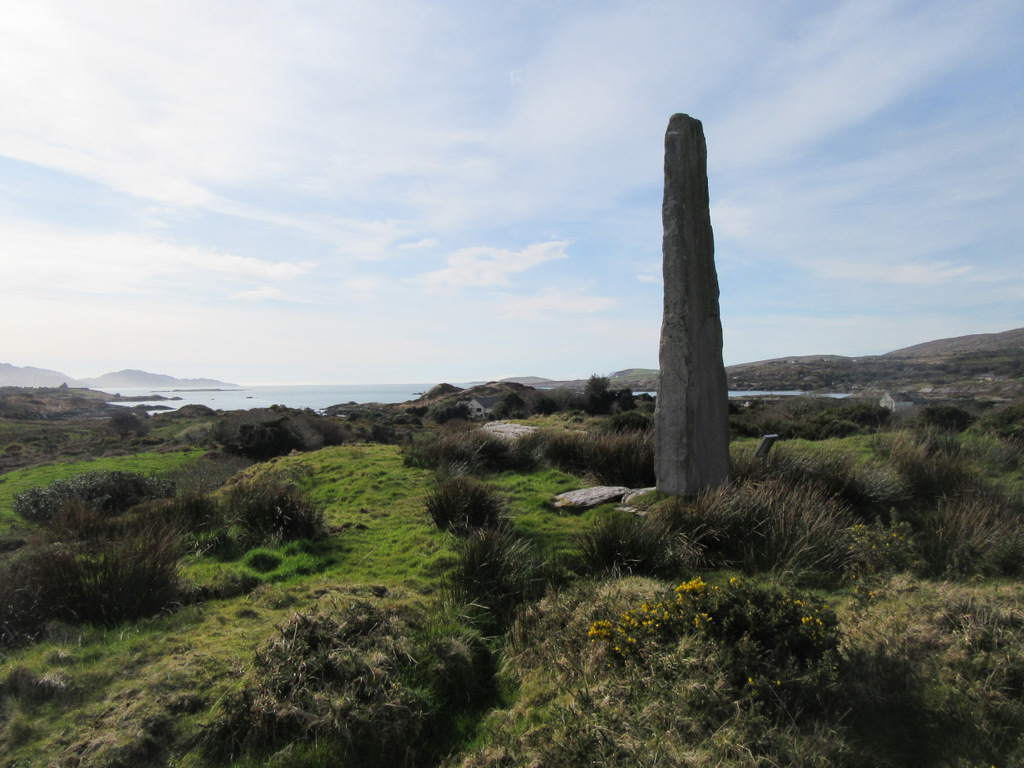
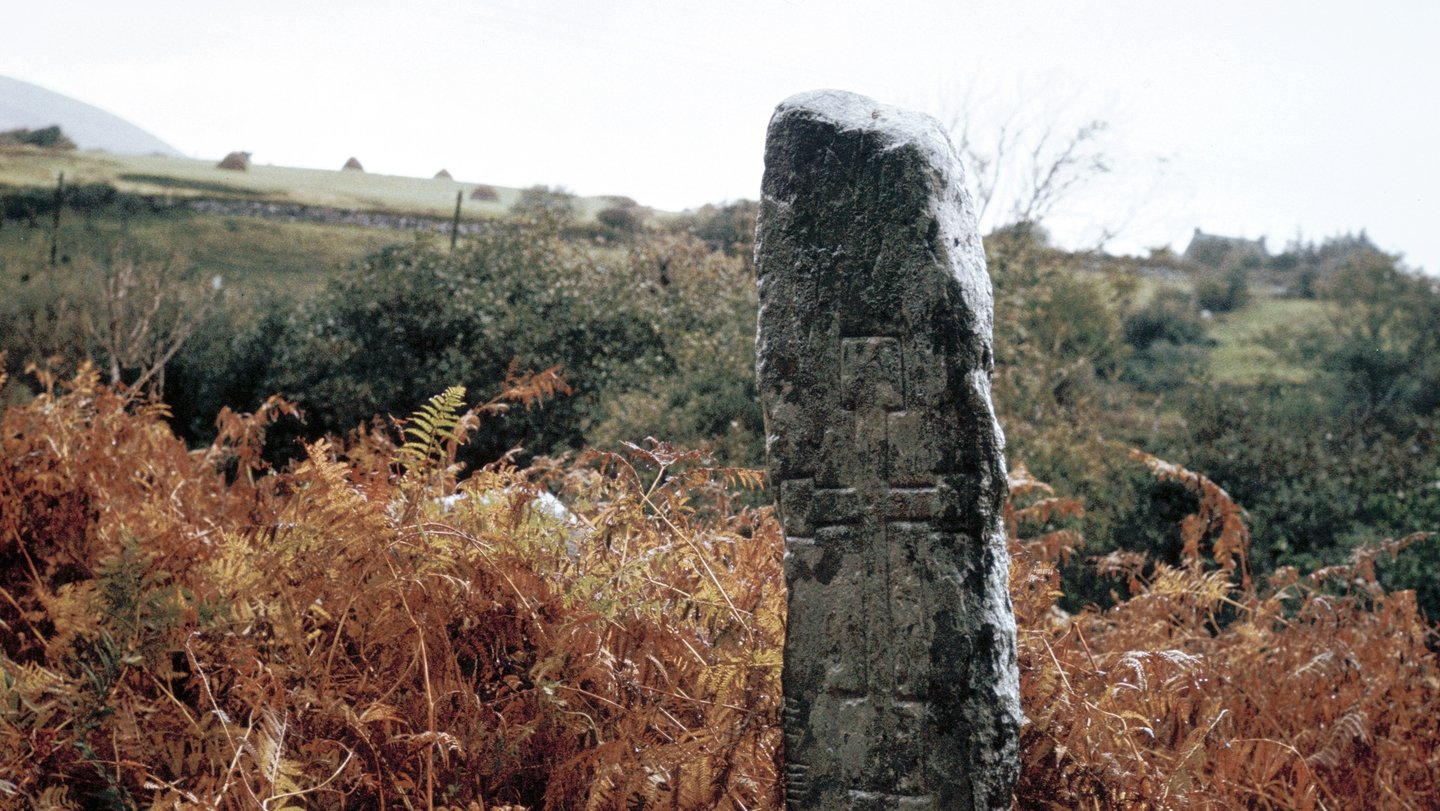
Ogham is unique among world writing systems. It consists solely of groups of 1, 2, 3, 4, or 5 parallel lines. The value of each group was dependent on its position relative to a central stemline. Unlike later inscriptions in the Latin script, which were carved on the face of the stone, ogham inscriptions were usually carved vertically along the natural angle or edge of the stone, which served as the stemline. Ogham generally reads upwards, starting at the bottom left-hand side of one of the faces, across the top and down the right-hand side (up-top-down), depending on the length of the inscription. However, there is a good deal of variation in this pattern, such as reading upward on both edges; up-top-down in reverse (up right-hand side and down left) and only very occasionally on the face of the stone. The manner in which the script wraps around the edge of the stone makes it a uniquely three-dimensional script.
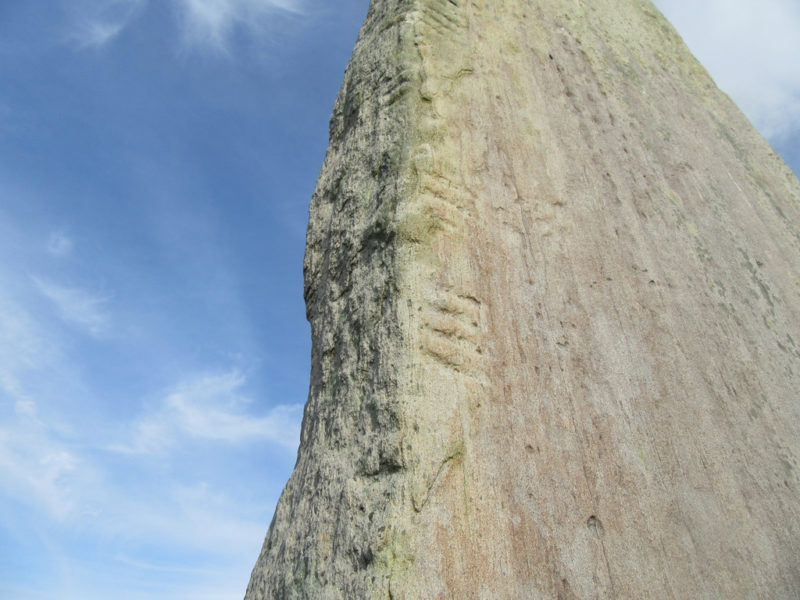
Ogham stones are found in most counties in Ireland, but occur in highest numbers in the southwest, in counties Kerry, Cork and Waterford. Kerry alone has approximately a third of the total and the Dingle peninsula has the highest concentration, with approximately 60 ogham stones. Ogham stones are also found in Britain, primarily in areas of post-Roman Irish colonization, in Wales, Devon and Cornwall in the southeast, and in Scotland and the Isle of Man. Interestingly, most of the Welsh inscriptions are bilingual, in Latin (script and language) on the face of the stone, and in ogham (and the Irish language) on the edge.
 |
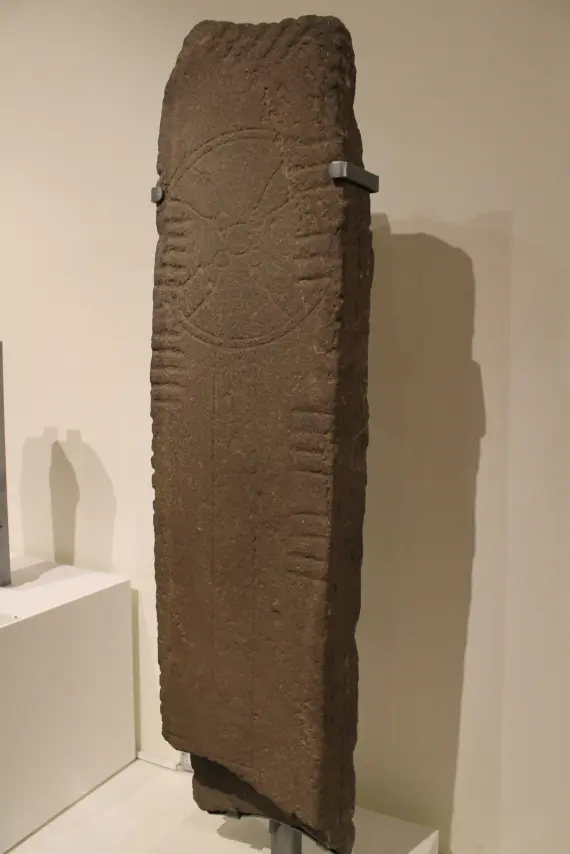
The Maltese cross in the center was carved before the ogham inscription (the ogham lies over the cross, and not vice-versa). |
But not all ogham inscriptions are written on stones, as seen in the inscriptions on the back of the 9th-10th century Ballyspellan brooch, Co. Kilkenny.
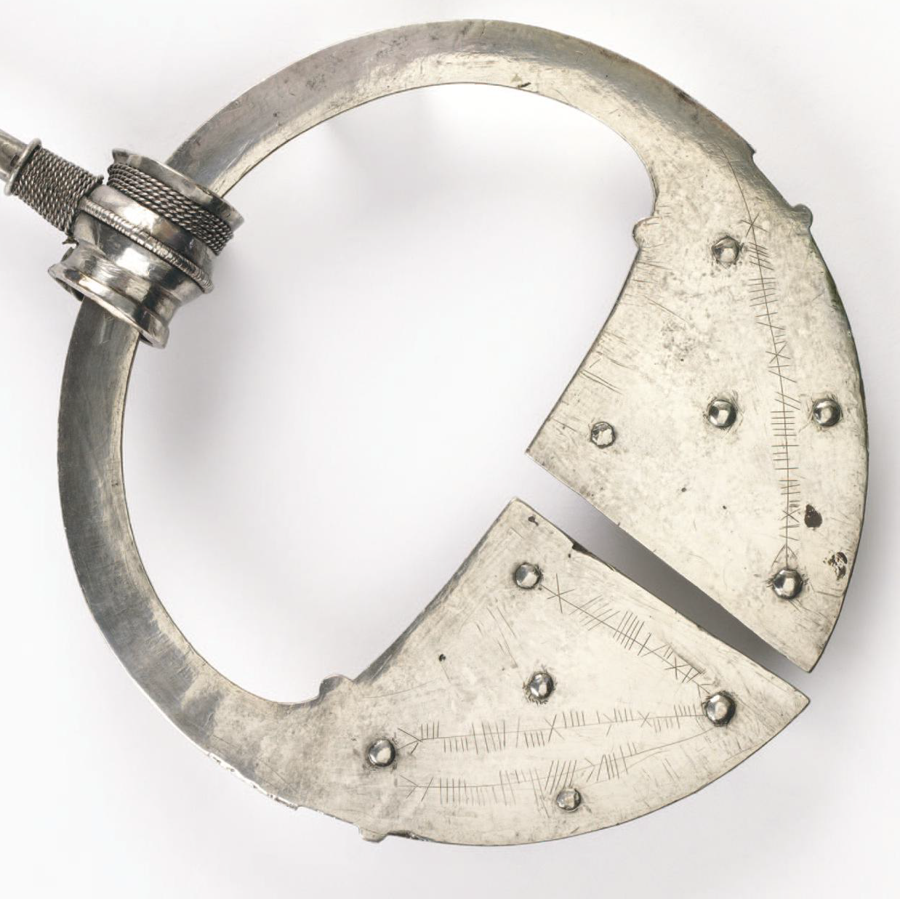
These four lines of ogham appear to be in a single hand and consist of personal names, presumably the successive owners of the brooch:
1. CNAEMSECH CELLACH ‘Cnáimsech, Cellach’, 2. MINODOR MUAD ‘Mín odor the noble’,
3. MAELMAIRE ‘Máel Maire’, 4. MAELUADAIG MAELMAIRE ‘Máel Úadaig (son of) Máel Maire’.
Ogham in history
The precise origins of Ogham are debated, but it’s widely accepted that it has roots in the Latin or Greek alphabets, adapted for the Insular Celtic languages. This script emerged during a time of significant Roman influence across Europe, although Ireland remained free of direct Roman rule. Despite this, the presence of Latin enabled the adaptation of Roman script to create Ogham, the earliest form of writing in the Irish language.
Ogham in myth
In Irish mythology, the creation of Ogham is attributed to Ogma, the god of eloquence and literature. This mythical narrative, which intertwines with the historical account, positions Ogma as the scribe of the Tuatha Dé Danann, the fabled ancestors of the Irish people who invented Ogham. We may be more familiar with an analogue of this myth, the story of the Tower of Babel. It outlines how a language and a script can unify a people while also distinguishing them from tribes. In the Lebor Gabála Érenn (The Book of Ireland's Taking) it is said that Fenius Farsaid, a legendary Scythian king, witnessed the confusion at Babel and thereafter developed the script as a means to consolidate language and knowledge. Both of these stories emphasise the cultural importance of Ogham as a symbol of wisdom and identity among ancient Celts, reflecting the Druids’ potential role in preserving sacred texts and transmitting knowledge orally before the advent of such scripts.
A note on this section:
Nora White is, essentially, the single most learned person on the planet when it comes to Ogham. She was the Principal Investigater for "Ogham in 3D," and her writings, both for academics and the popular press, are required reading if you want to understand these stones and this alphabet.
Basiouny, Noha. "Ogham Stones and Ancient Messages: Deciphering the Secrets of Early Irish Inscriptions." Connolly Cove, 24 April 2024.
"Ogham in 3D." Dublin Institute for Advanced Studies, School of Celtic Studies, 30 July, 2023.
O'Brien, Lora. "What Are Ogham Stones?" Ogham Academy, 25 January 2024.
White, Nora. Our Ancient Landscapes: Ogham Stones in Ireland. An Chomairle Oidhreachta / The Heritage Council, 2021,
Glosses and Marginalia
Technically, glosses—those instances of smaller snippets of text inserted between the lines of the primary texts—are called interlinear glosses. There are two types: 1) lexical, which provides an explanation of difficult vocabulary or terminology, and 2) suppletive, which addressed a point of grammar. Although many were added in Latin, they might be written in any number of other languages. Glosses, as opposed to some instances of impulsive marginalia, had a didactic purpose and were rarely spontaneous. When a volume with these glosses in it was recopied by another scribe, these glosses were added to the volume and included in later copies.
Marginalia, the drawings and other marks made along the edges of pages, are a far more varied lot. This grouping also has two major categories: 1) illustrations intended to accompany the text, and 2) annotations made by scribes, owners, and readers. Both types can be serious, playful, fantastic, disgusting, or any state in between.
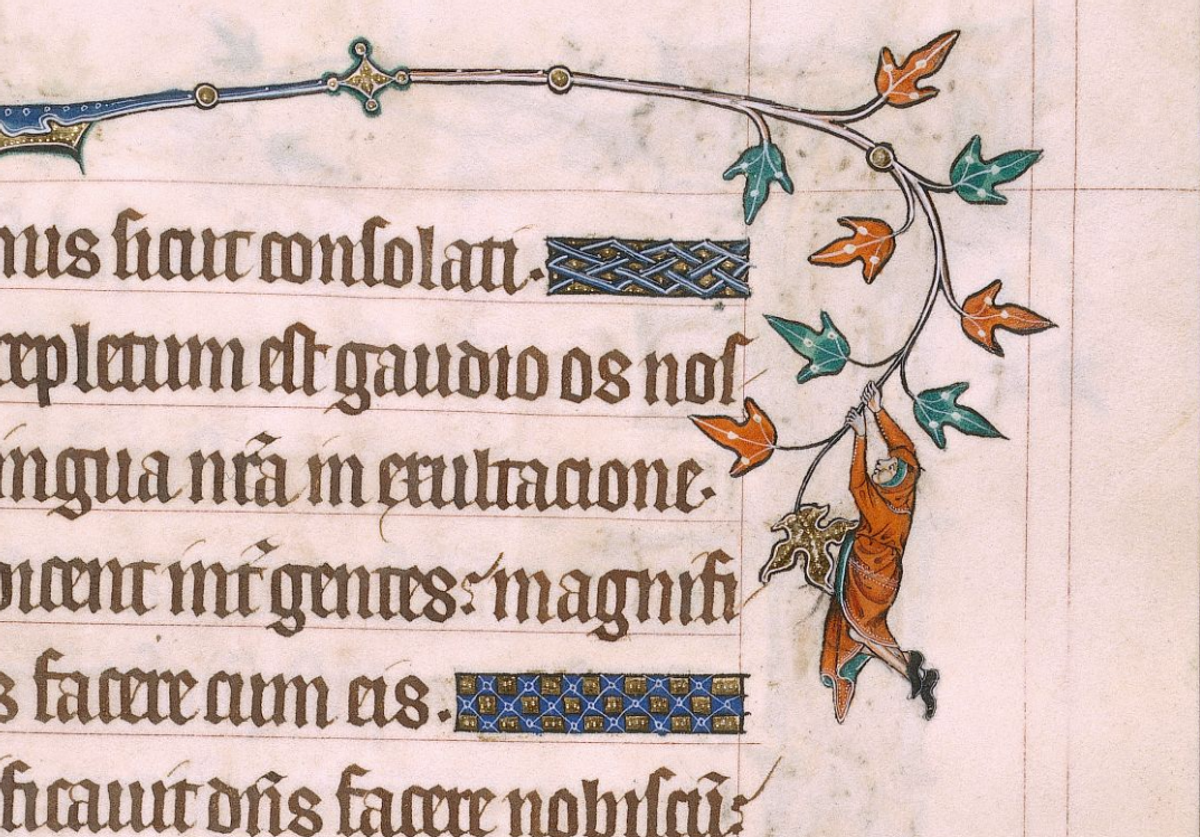
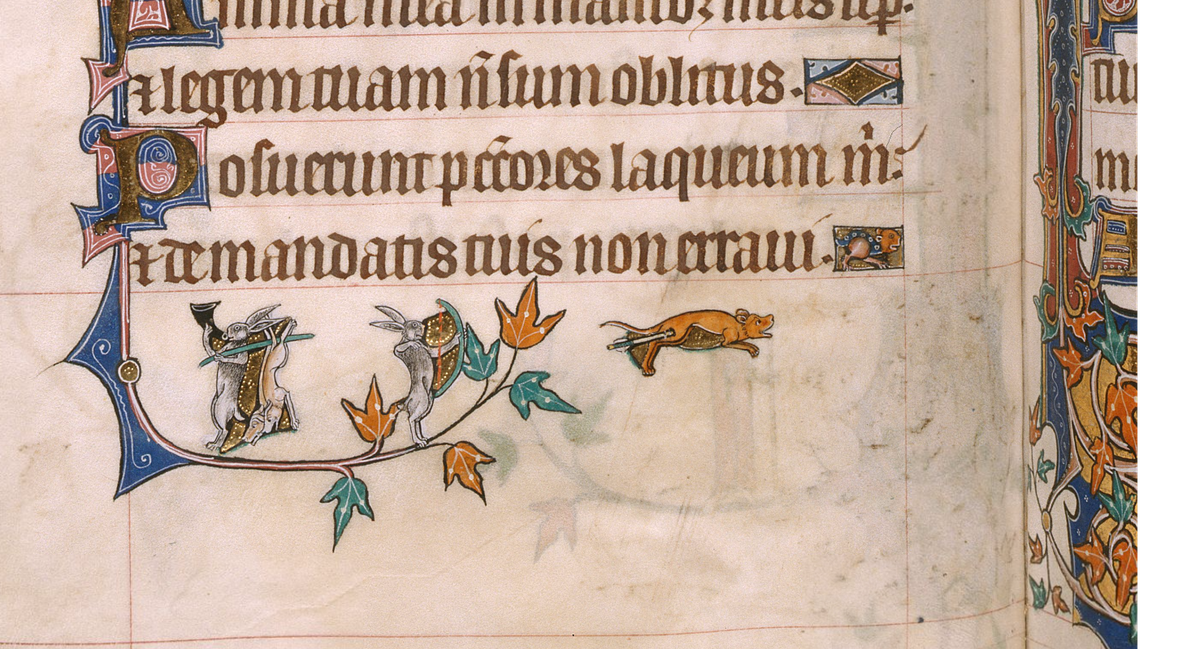
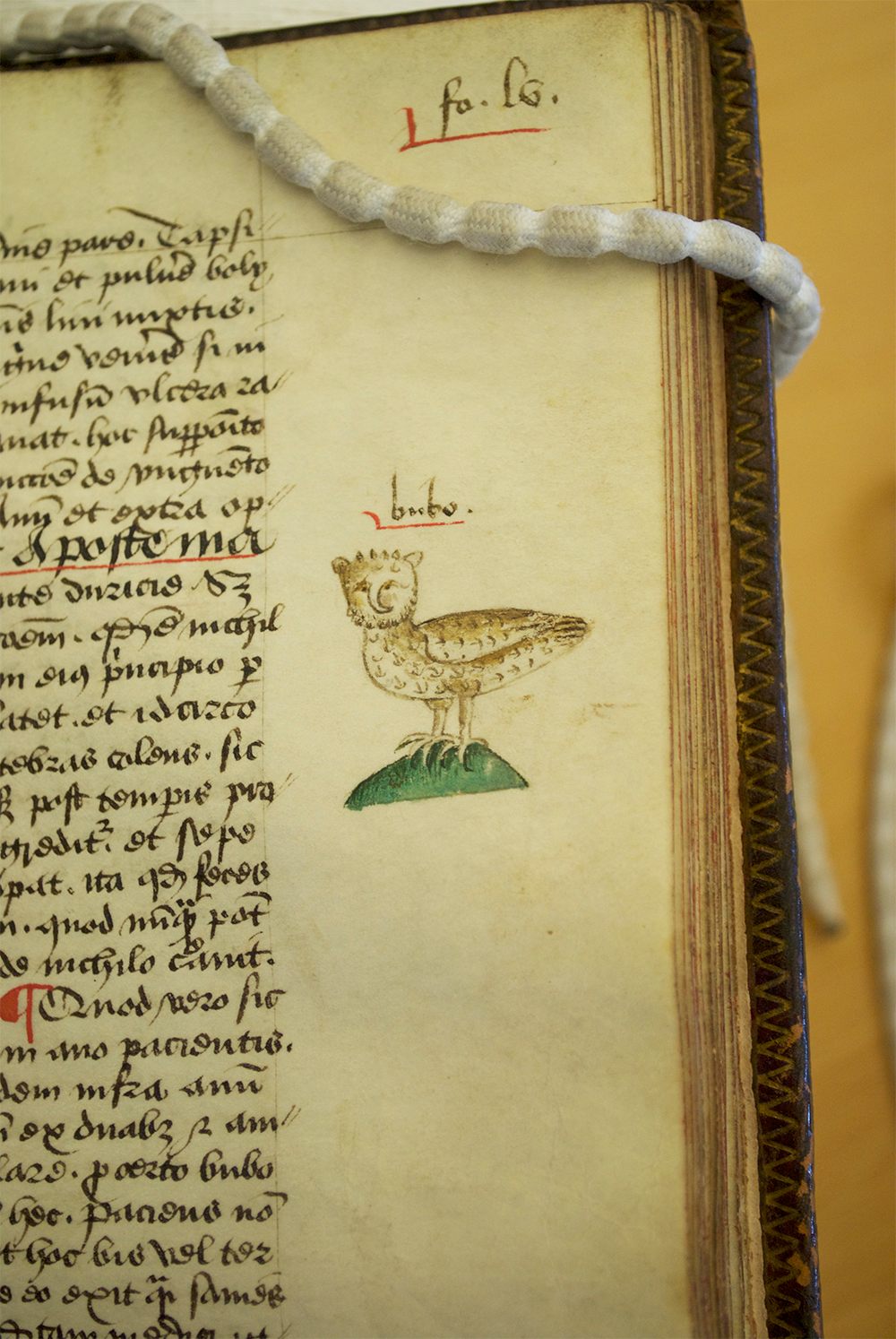
and the word used for an inflamed, tender swelling of a lymph node, especially in the armpit or groin.
This would help a reader find the relevant section.
Perhaps the most famous source for material of this kind in Irish is a mid-9th-century manuscript in the Stiftsbibliothek of St. Gallen in Switzerland, known as Codex Sangallensis 904. It contains a copy of Priscian’s Institutiones Grammaticae (6th century), one of the most important sources for the instruction of Latin in the Middle Ages. This ms is simply known as "The St. Gall Glosses." The main text is written in large script, but between the lines and in the margins are much smaller annotations, explanations, and comments, written in Latin and in Old Irish. Mostly these are explanatory teaching notes, but in the margins of folios 203 and 204 is a gloss considered one of the highlights of medieval Irish nature poetry.
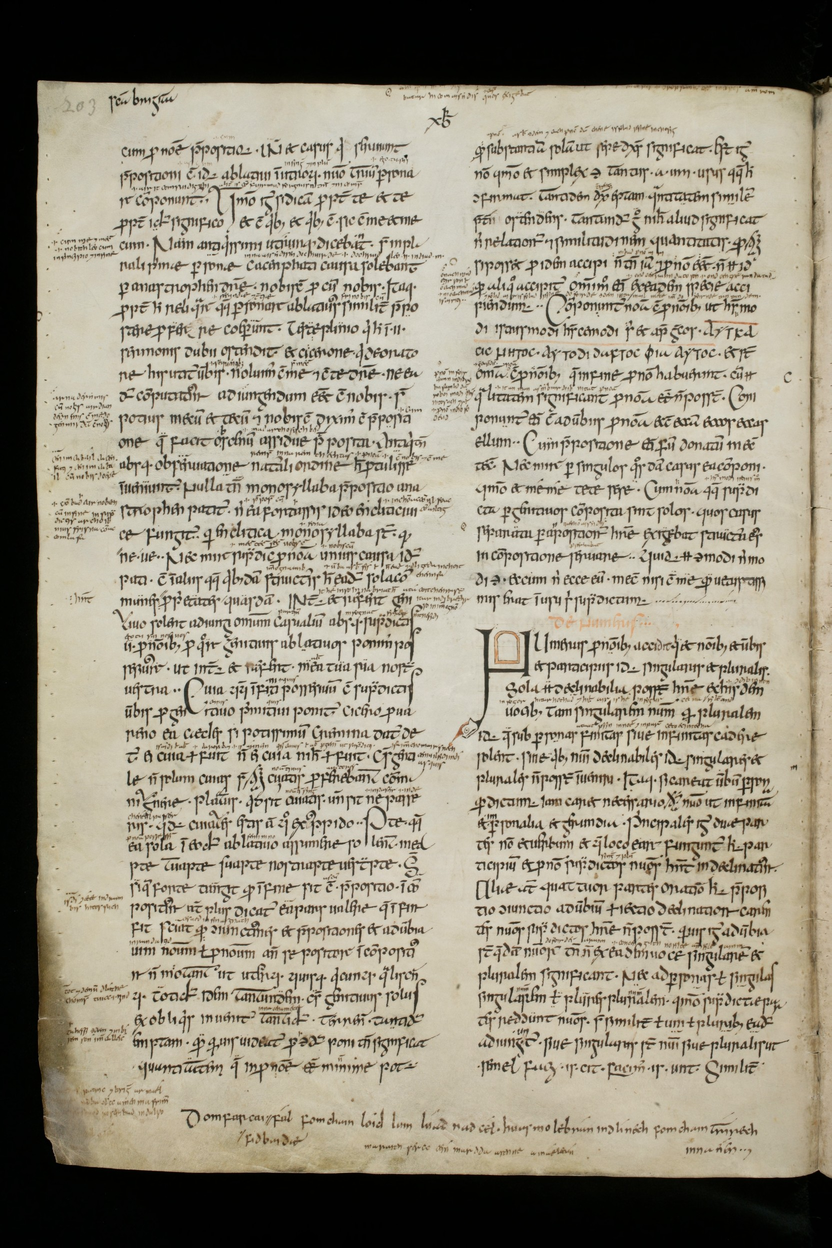
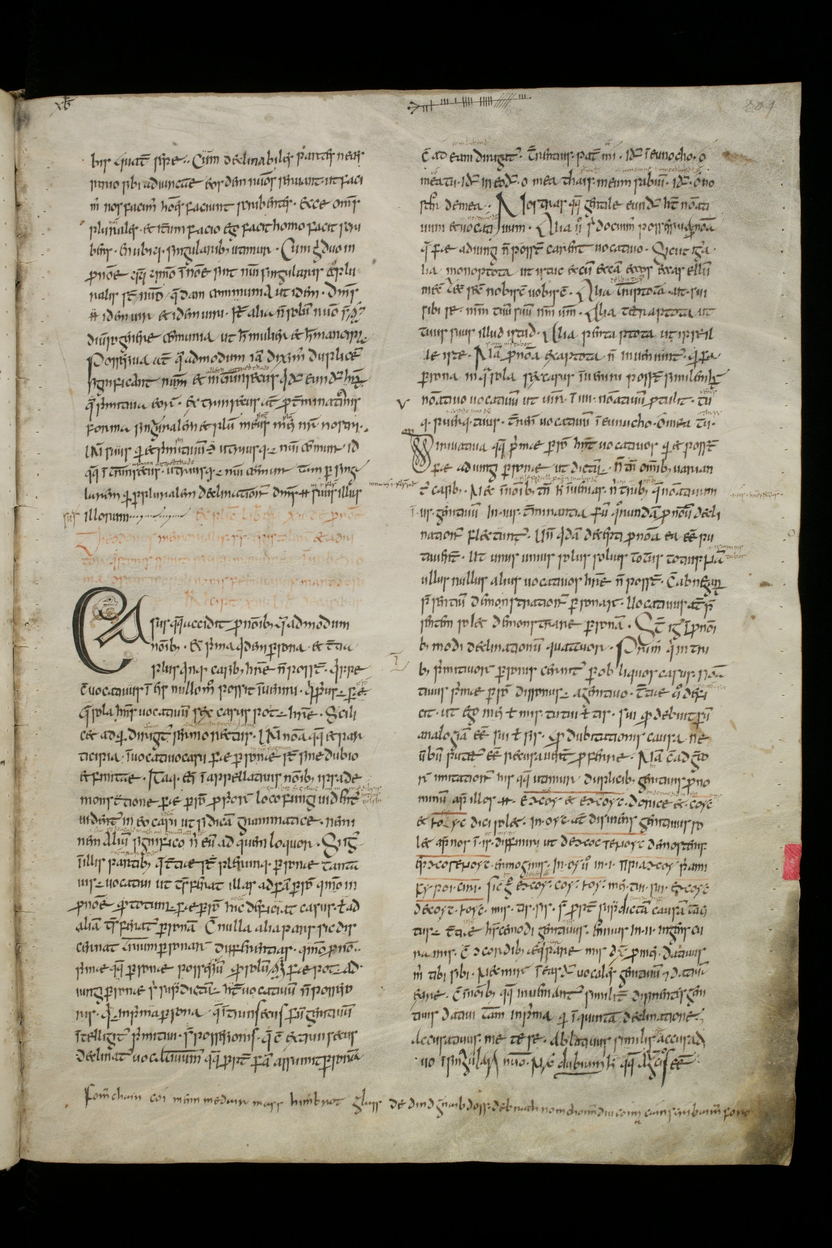
| The original poem (Gerard Murphy transcription) |
Translation by Seamus Heaney and Timothy O'Neill |
|
Dom-ḟarcai fidbaide fál fom-chain loíd luin, lúad nād cél; hūas mo lebrán, ind línech, fom-chain trírech inna n-én. Fomm-chain coí men, medair mass, hi mbrot glass de dingnaib doss. Debrath! nom-Choimmdiu-coíma: caín-scríbaimm fo roída ross. |
Pent under high tree canopy, A blackbird, listen, sings for me, Above my little book’s ruled quires I hear the wild birds jubilant. From a shrub covert, shadow-mantled A cuckoo’s clear sing-song delights me. O at the last, the Lord protect me! How well I write beneath the wood. |
Short Lyric Poems
Pangur Bán
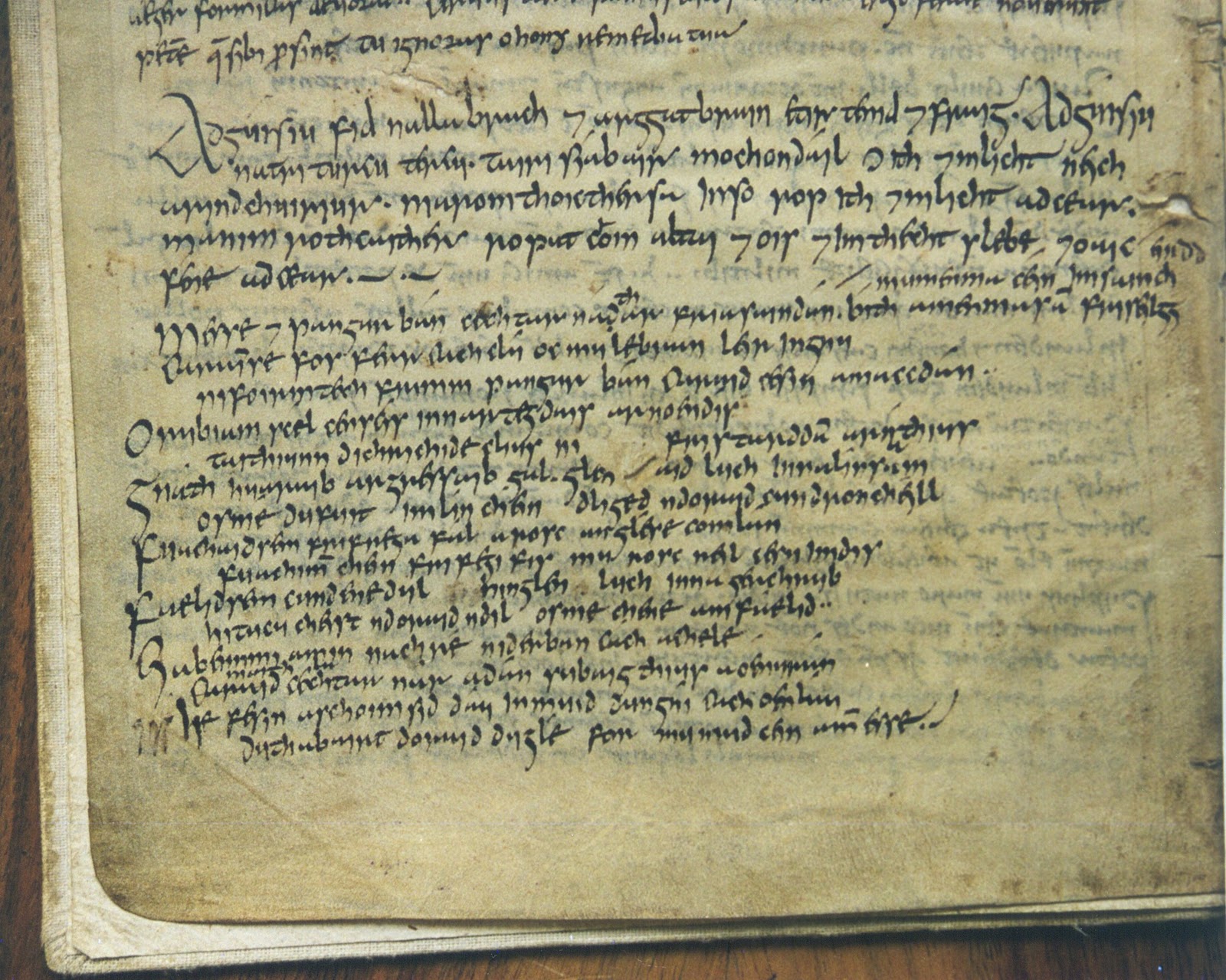
This poem has been translated a number of times. Below are some of the most famous attempts.
| Original Old Irish | translated by Robin Flower | translated by Seamus Heaney | translated by WH Auden |
|
Messe ocus Pangur Bán, cechtar nathar fria saindán; bíth a menma-sam fri seilgg, mu menma céin im saincheirdd Caraim-se fos, ferr cach clú, oc mu lebrán léir ingnu; ní foirmtech frimm Pangur bán , caraid cesin a maccdán. Ó ru·biam — scél cen scís — innar tegdais ar n-óendís, táithiunn — díchríchide clius — ní fris tarddam ar n-áthius. Gnáth-húaraib ar gressaib gal glenaid luch inna lín-sam; os mé, du·fuit im lín chéin dliged n-doraid cu n-dronchéill. Fúachid-sem fri frega fál a rosc anglése comlán; fúachimm chéin fri fégi fis mu rosc réil, cesu imdis, Fáelid-sem cu n-déne dul hi·n-glen luch inna gérchrub; hi·tucu cheist n-doraid n-dil, os mé chene am fáelid. Cía beimmi amin nach ré, ní·derban cách ar chéle. Maith la cechtar nár a dán, subaigthius a óenurán. Hé fesin as choimsid dáu in muid du·n-gní cach óenláu; du thabairt doraid du glé for mu mud céin am messe. |
"The Scholar and His Cat, Pangur Bán" I and Pangur Ban my cat, ‘Tis a like task we are at: Hunting mice is his delight, Hunting words I sit all night. Better far than praise of men ‘Tis to sit with book and pen; Pangur bears me no ill-will, He too plies his simple skill. ‘Tis a merry task to see At our tasks how glad are we, When at home we sit and find Entertainment to our mind. Oftentimes a mouse will stray In the hero Pangur’s way; Oftentimes my keen thought set Takes a meaning in its net. ‘Gainst the wall he sets his eye Full and fierce and sharp and sly; ‘Gainst the wall of knowledge I All my little wisdom try. When a mouse darts from its den, O how glad is Pangur then! O what gladness do I prove When I solve the doubts I love! So in peace our task we ply, Pangur Ban, my cat, and I; In our arts we find our bliss, I have mine and he has his. Practice every day has made Pangur perfect in his trade; I get wisdom day and night Turning darkness into light. |
Pangur Bán and I at work, Adepts, equals, cat and clerk: His whole instinct is to hunt, Mine to free the meaning pent. More than loud acclaim, I love Books, silence, thought, my alcove. Happy for me, Pangur Bán Child-plays round some mouse’s den. Truth to tell, just being here, Housed alone, housed together, Adds up to its own reward: Concentration, stealthy art. Next thing an unwary mouse Bares his flank: Pangur pounces. Next thing lines that held and held Meaning back begin to yield. All the while, his round bright eye Fixes on the wall, while I Focus my less piercing gaze On the challenge of the page. With his unsheathed, perfect nails Pangur springs, exults and kills. When the longed-for, difficult Answers come, I too exult. So it goes. To each his own. No vying. No vexation. Taking pleasure, taking pains, Kindred spirits, veterans. Day and night, soft purr, soft pad, Pangur Bán has learned his trade. Day and night, my own hard work Solves the cruxes, makes a mark. |
Pangur, white Pangur, How happy we are Alone together, scholar and cat Each has his own work to do daily; For you it is hunting, for me study. Your shining eye watches the wall; My feeble eye is fixed on a book. You rejoice, when your claws entrap a mouse; I rejoice when my mind fathoms a problem. Pleased with his own art, neither hinders the other; Thus we live ever without tedium and envy. |
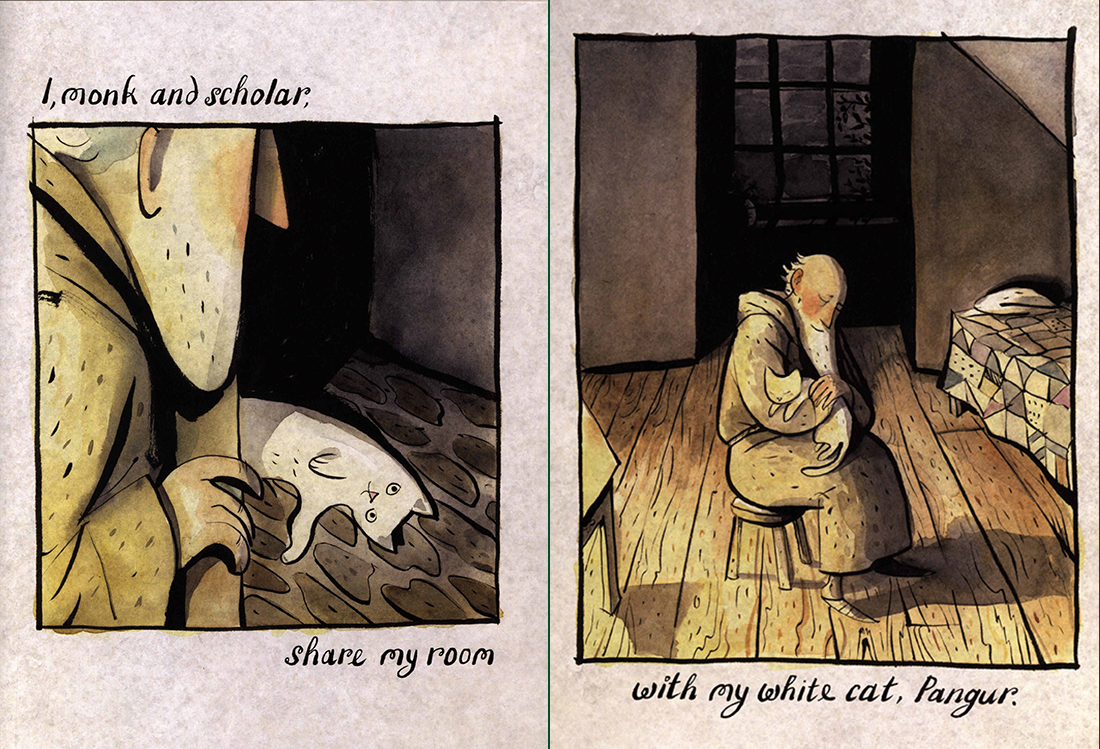
Seamus Heaney's "Translator's Notes" for Pangur Bán (he appended these when his translation appeared in Poetry):
This poem, found in a ninth-century manuscript belonging to the monastery of St. Paul in Carinthia (southern Austria), was written in Irish and has often been translated. For many years I have known by heart Robin Flower’s version, which keeps the rhymed and endstopped movement of the seven-syllable lines, but changes the packed, donnish/monkish style of the original into something more like a children’s poem, employing an idiom at once wily and wilfully faux-naif:
I and Pangur Bán, my cat,
’Tis a like task we are at...,”
“’Tis a merry thing to see
At our tasks how glad are we
When we sit at home and find
Entertainment for our mind,”
and so on.
Sometimes known as “Pangur Bán” (“white pangur”—“pangur” being an old spelling of the Welsh word for “fuller,” the man who works with white fuller’s earth), sometimes known as “The Scholar/Monk and his Cat,” the poem pads naturally out of Irish into the big-cat English of “The Tyger.” And since Blake’s meter acted as Flower’s tuning fork, and as Yeats’s when Yeats came to write his exhortations to Irish poets, I was glad to “keep the accent” and thereby instate the author of “Pangur Bán” at the head of the line of those Irish poets who are meant to have “learned their trade.”
Like many other early Irish lyrics—“The Blackbird of Belfast Lough,” “The Scribe in the Woods,” and various “season songs” by the hermit poets—“Pangur Bán” is a poem that Irish writers like to try their hand at, not in order to outdo the previous versions, but simply to get a more exact and intimate grip on the canonical goods. Nevertheless, had it not been for the editor’s invitation to contribute to this issue, it’s unlikely that I would ever have made bold to face the job: the tune of the Flower version is ineradicably lodged in my ear, and I just assumed that for me “Pangur Bán” would always be a no-go area.
A hangover helped. Not so much “tamed by Miltown” as dulled by Jameson, I applied myself to the glossary and parallel text in the most recent edition of Gerard Murphy’s Early Irish Lyrics (Four Courts Press, 1998) and was happy to find that I had enough Irish and enough insulation (thanks to Murphy’s prose and whiskey’s punch) to get started.
Brehon Laws
The tracts contained within the Senchas Már contain without a doubt the most glosses and intralinear commentaries in the Old Irish corpus. While there are plenty of tracts addressing usual legal matters, one of the most interesting sections is the Bechbretha, or the Bee-Judgments. This set of tracts was probably composed in the 7th century. The honeybee (Old Irish bec) was very important in the early Irish economy. There are many references to bees in other law-texts, in Saints' Lives, in sagas, and in poetry. As well as honey (Old Irish mil), each monastery required considerable quantities of beeswax (Old Irish céir) for candle-making, the waxed tablets used to practise scribal techniques, seals and adhesives. Much of the Bechbretha is concerned with the legal intricacies of handling bee swarms. The law shown below states that, if a person finds a stray swarm on waste land or land that was the common property of the tribe, they can claim both the bees and the honey they produce as their own, but must, for the first year, give 1/9 of the honey produced to their clan chief.
The Bechbretha explored many nuances about bees and the honey they produced. If someone found a swarm in a faithche (the green, or yard, or kept space surrounding and belonging to a house), 1/4 of the honey produced for the first year was due to the finder, and the remaining 3/4 went to the owner of the house. If, however, someone found a swarm in a tree growing in a faithche, 1/2 of the honey produced for the first year went to the finder, and the other half to the owner of the house. If the swarm was found on land which was not a faithche, 1/3 went to the finder and 2/3 to the owner of the land. If a swarm was found on waste land, or land that was the common property of the tribe, the bees and honey belonged to the finder, except 1/9 mentioned above. And because any bees owned by an individual gathered their pollen from the surrounding district, the owners of the four adjacent farms were entitled to a certain small proportion of the honey produced every year. And after the third year of production, each of the four was entitled to a swarm from the colony. If bees belonging to one man swarmed onto the land of another, the produce was divided in certain proportions between the two.
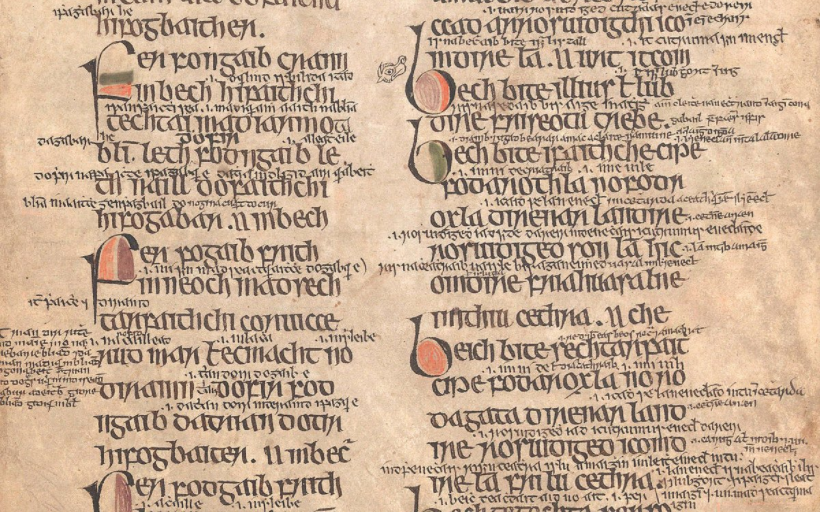
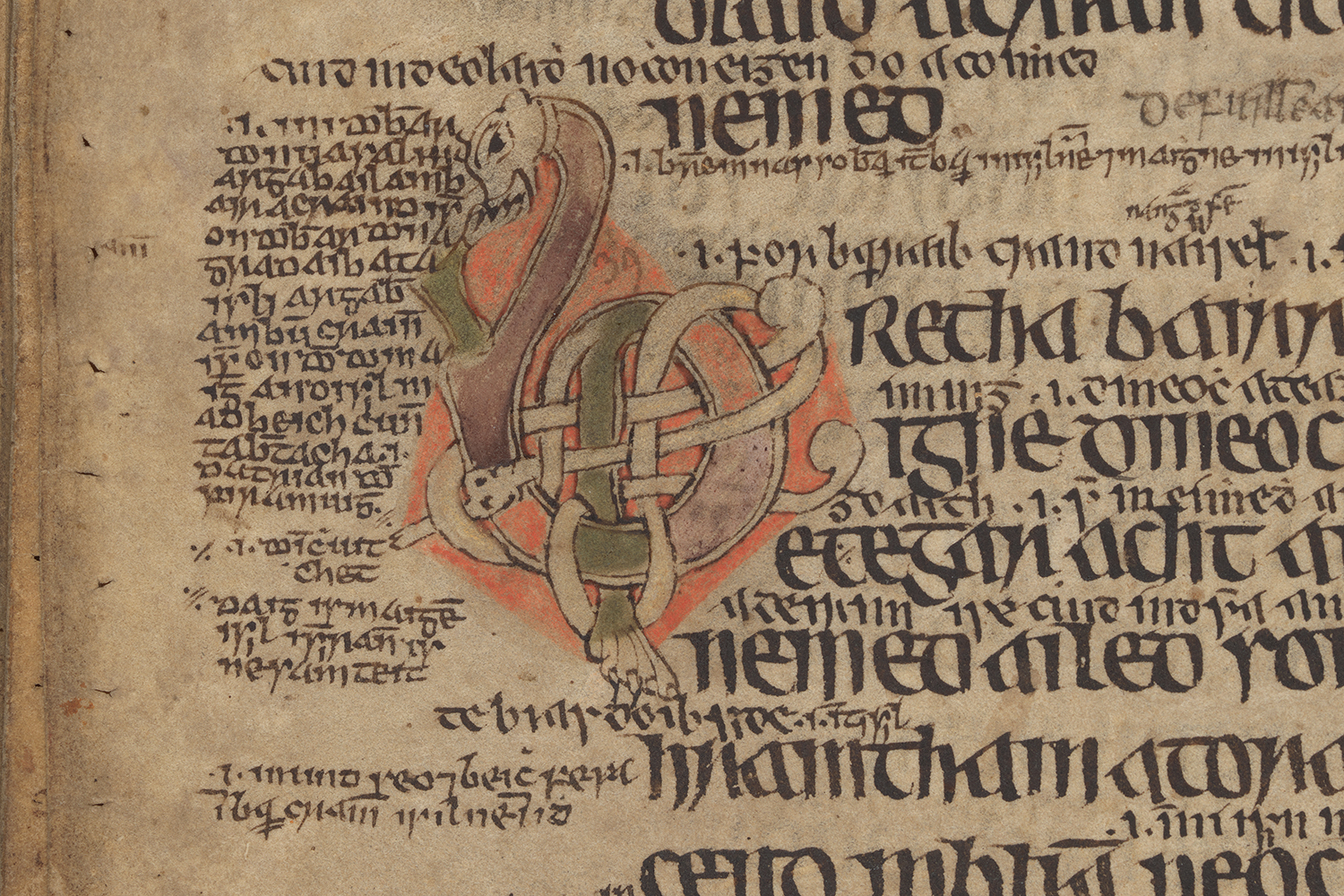
At the bottom of the second page above there's a sweet little bit of marginalia, where the scribe gives his name (Hugh McEgan), his age (21), and the date (Christmas Eve, 1350). By then the Black Death had been in Ireland for two years. He asks anyone who reads the page to say a prayer for his soul. Those prayers may have sustained him for a while, but the Annals of Ulster record his death in 1359, at the age of 30.
Annals
Yes, these are histories, with a number of entries for each year. But they're also full of witty and humane little pieces, as the monks who kept them couldn't help themselves; they had to write little commentaries on the events of their times. For instance, here's one of the entries in The Annals of The Four Masters for the year 890:
Ard Macha was plundered by Glún Iarainn, and the foreigners of Áth Cliath; and they carried off seven hundred and ten persons into captivity, after having destroyed a part of the church, and broken the oratory.
That's giving pretty short shrift to the destruction of the most important church in Ireland. Ard Macha was originally a hill fort; the modern city (and county) of Armagh in Northern Ireland developed around it. In the 5th century St. Patrick established his principal church in Ireland on this site. It was rebuilt later, and became a medieval ecclesiastical capital. But the scribal commentary near this entry is far more interesting than the terse entry above:
Pity, O Sainted Patrick
That your prayers did not stay
The foreigners with their axes
When smiting your oratory!
* These guides use five special symbols, taken from Mark Williams' Ireland’s Immortals: A History of the Gods of Irish Myth, Princeton UP, 2016.
ə |
the uh sound at the end of sofa |
|
a throaty gh sound, similar to the -ch in Scots loch but further back and down in the gullet. Not to be confused with the letter "y" |
kh |
the ch in Scots loch, spelled with a k– to avoid confusion with the ch in English child. |
ð |
the th– sound at the start of those, that, and than, which is different from the th– sound at the beginning of thick, thin, or think. |
ʸ |
indicates that the preceding consonant is "palatal," that is, accompanied by a y-glide like the m in mew or the c in cute (contrast moo and coot). This often occurs at the end of a word: in a form like the place-name Crúachain, which would be KROO-əkh-ənʸ. The y is there simply to indicate that the final consonant is pronounced like the first n in onion; it does not add a syllable. |