TIMELINE OF IRISH LITERATURE
from 600 BCE to 1850 CE
DECLINE OF THE GAELIC ORDER / DISPOSSESSION — c. 1600 CE - 1690 CE
ASH-ling
An Spéirbhean
ahn SPEER-bahn
Foras Feasa ar Éirinn
FOR-us FAH-sa arr EH-rehn
Dáibhí Ó Bruadair
DAH-vee oh BROO-ah-dair
Context
You can sum up the 17th century in Ireland in three words: the beatdown continues.
The century begins with the Battle of Kinsale in 1601, precipitated by Hugh O’Neill and Red Hugh O’Donnell, two northern clan leaders who had previously united to drive the English invaders out of their land. Six years later, the two remaining northern Earls of Ireland, along with nearly 100 family members and followers, fled the country to Spain, with no reason or explanation but with a lot of haste. This event became known as the Flight of the Earls, and marked a turning point for Ireland.
The Stuart monarchs who ruled England after Elizabeth's death in 1603 had profound effects on Ireland, none of them positive. After Elizabeth, the throne passed to James VI of Scotland, who then became James I of England. He reigned until 1625, when Charles I became king and reigned until he was executed in 1649.
There were still significant religious factionalism in Ireland, with the Gaels and the Old English remaining loyal to the Catholic church, while the Scottish colonists were more Calvinist and the New English Protestants tended to favor Lutheranism. The populations of Ireland and Ulster were both still majority Catholic, with isslands of Protestant settlements dotted among them. But the New English Protestants were in control in the Pale in Dublin, aand they ran the administration of the island.
Characteristics
Shift in Patronage
The defeat of the Gaelic aristocracy and the "Flight of the Earls" (1607) dealt a severe blow to the traditional system of patronage for bardic poets, leading to its decline.
Lament and Satire
Poetry increasingly reflected the loss of Gaelic power, expressing lament, elegy for fallen patrons, and satire against the new English order.
Historical and Genealogical Works
Efforts to preserve Gaelic history and lineage continued, often by scholars and scribes working under changed circumstances.
Rise of the Aisling
A new poetic form, the aisling (vision poem), emerged during this period. In an aisling, the island of Ireland appears to the poet in a vision in the form of a woman, sometimes young and beautiful, sometimes old and haggard. This female figure is generally referred to in the poems as An Spéirbhean (the sky-woman). She laments the current state of the Irish people and predicts an immanent revival of their fortunes, usually linked to the return of a Stuart pretender to the English throne. These works are essentially allegorical expressions of national aspirations for unity and self-determination.
Key Events
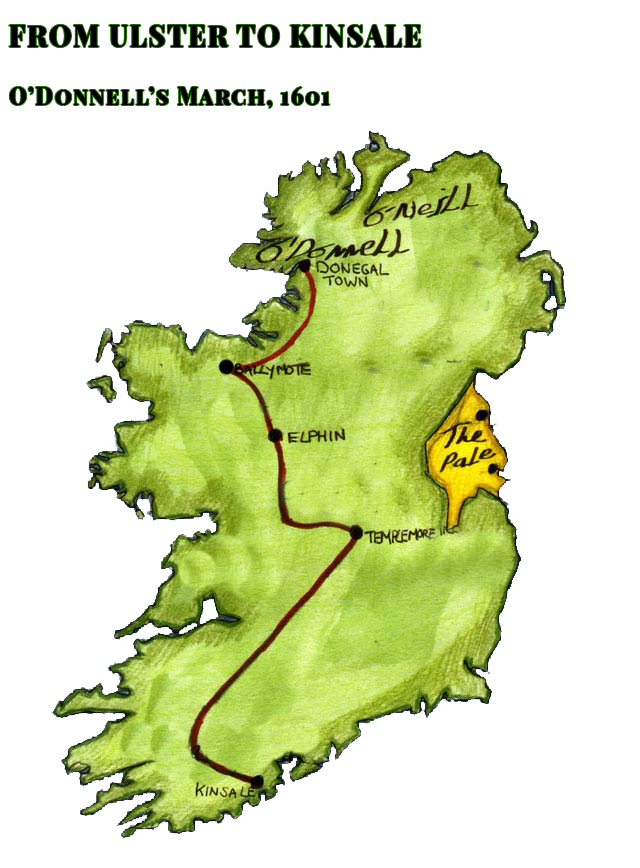
Battle of Kinsale (1601) and Flight of the Earls (1607)
Marked the effective end of the old Gaelic order and its traditional patronage. In 1601 a Spanish army of 4,800 men landed in Kinsale in support of Hugh O’Neill and Red Hugh O’Donnell, two clan leaders/Earls from Ulster who had successfully driven the English from their lands. However, Kinsale is in Co. Cork, an entire island awy from Ulster. The English laid seige to the Spanish forces, and O’Neill and O'Donnell marched south in an attempt to break the siege. When they engaged the English, the battle lasted only an hour. Th Irish lost 1,200 men, the English only 20. The Irish scattered and the Spanish surrendered.
O’Neill eventually surrendered to the English in 1603, after having most of his land and authority removed and replaced by more Loyalist characters. Both he and O'Donnell had succumbed to British power and therefore became Earls of Tyrone and Tyrconnnell, however, it wasn't long before the restricted incomes, lesser status, and overwhelming pressure from the crown began to take its toll. By 1607 O'Neill (the Earl of Tyrone) and Rory O’Donnell (the Earl of Tyrconnell and Red Hugh O'Donnell's brother) were the last two remaining earls that held even the smallest amount of power in the north of Ireland.
Both men feared they would be arrested for treason, so the two Earls and most of their families and followers boarded a ship in in Donegal in the dead of night and left Ireland. They hoped to enlist the help of Phillip III of Spain again, but he had signed a peace treaty with England in 1604, so no help was coming. Both of the Earls died in exile.
For the Gaelic Irish, the Flight of the Earls was to have dramatic implications. It left Ulster open to plantation as the lands formerly ruled by the nobles were now deemed forfeited. Their lands were confiscated and taken by the crown for plantation. Whatever the loss suffered by the nobility, the Plantation of Ulster was to have a dreadful impact on the Gaelic commoners in the province.
Plantations (17th century)
Widespread confiscation of Irish land and settlement by English and Scottish Protestants, further eroding Gaelic society and the Irish language's prestige.
1641 Rebellion and Cromwell
The native Irish reaction to plantation came to a head in the "Great Rebellion" of 1641. It dragged on for eleven years and caused wholesale death and destruction throughout the whole island. But then Oliver Cromwell, at the head of the British Army, came to Ireland to put this rebellion down "once and for all." He marched on every Irish city, slaughtering any resistors. For instance, when his army entered Drogheda, there were only the remaining defeated soldiers and 3,000 unarmed civilians left in the town. Cromwell's gave his soldiers free reign to kill combatants and non-combatants alike. When the slaughter was over, only thirty Irish people remained.
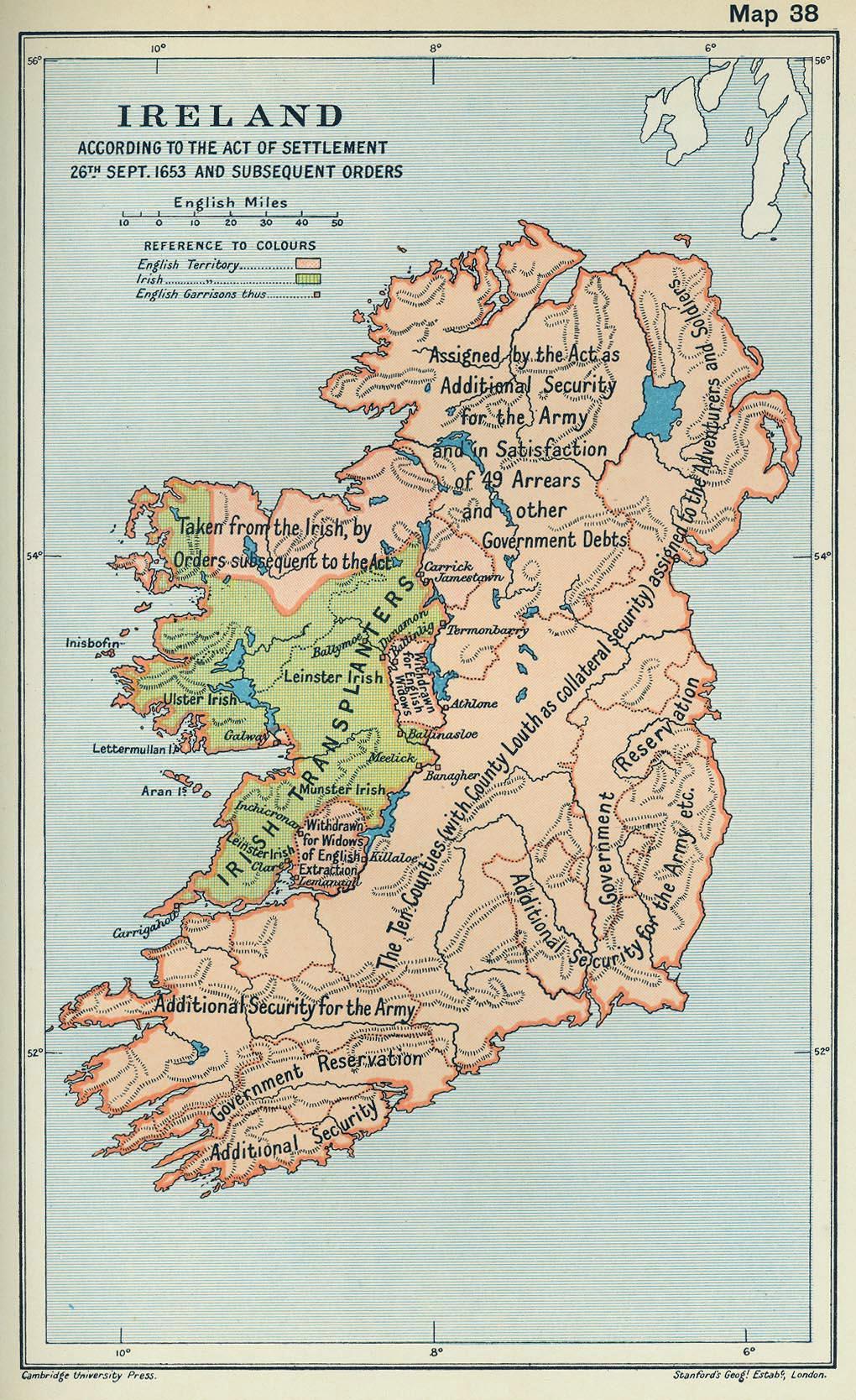
Because of the savagery with which this rebellion had been put down, the English authorities believed that Irish rebellions were a thing of the past. They soon found out that they were wrong. New trouble started in 1685 when Charles II, King of England, died and was succeeded by James II, a Catholic. The native Irish gave him their whole-hearted support, because they believed that he would restore their lands to them. But the powerful nobles in England, who were predominantly Protestant, were not about to lose their power without a fight. They invited William of Orange to come to England to be their king, an offer he happily accepted.
In 1688 William defeated James, who promptly fled to France to set up plans for regaining his throne. His strategy was to first gain a beachhead in Ireland, where he knew he had overwhelming support. He landed in Ireland in 1689 and won a quick series of battles. Shortly after, however, William and his army landed in Ireland and on July 1, 1690 they defeated James in the famous Battle of the Boyne.
Penal Laws (late 17th century onwards)
A series of discriminatory laws against Irish Catholics, impacting their education, land ownership, and public life, further marginalized Irish culture and language.
Notable Authors and Works
Geoffrey Keating (c.1579 - c.1644)
Author of Foras Feasa ar Éirinn (literally, Foundation of Knowledge on Ireland, but commonly known as History of Ireland), a comprehensive prose history that sought to defend Irish tradition and refute English narratives.
Dáibhí Ó Bruadair (c.1625 - 1698)
A significant poet who bridged the gap between the bardic tradition and the new, more popular forms, often lamenting the decline of the Gaelic order. He wrote elegies on the deaths of many historically prominent members of the leading Munster families. All his poems, whether historical, social, or elegiac, include many interesting details about the life and manners of his time. He wrote bitter satires of the Cromwellian Planters and the Duke of Ormonde and his lackeys.
Henry Burkhead (active mid-17th century)
Wrote A Tragedy of Cola's Furie or Lirenda's Miserie (1646), reflecting the turmoil of the period.

* These guides use five special symbols, taken from Mark Williams' Ireland’s Immortals: A History of the Gods of Irish Myth, Princeton UP, 2016.
ə |
the uh sound at the end of sofa |
|
a throaty gh sound, similar to the -ch in Scots loch but further back and down in the gullet. Not to be confused with the letter "y" |
kh |
the ch in Scots loch, spelled with a k– to avoid confusion with the ch in English child. |
ð |
the th– sound at the start of those, that, and than, which is different from the th– sound at the beginning of thick, thin, or think. |
ʸ |
indicates that the preceding consonant is "palatal," that is, accompanied by a y-glide like the m in mew or the c in cute (contrast moo and coot). This often occurs at the end of a word: in a form like the place-name Crúachain, which would be KROO-əkh-ənʸ. The y is there simply to indicate that the final consonant is pronounced like the first n in onion; it does not add a syllable. |