TIMELINE OF IRISH LITERATURE
from 600 BCE to 1850 CE
"HIDDEN IRELAND" / EARLY ANGLO-IRISH — c. 1690 CE - 1800 CE
ash´-leeng
Aogán Ó Rathaille
EH-gun Oh RAH-hill-lə
Eoghan Rua Ó Súilleabháin
OH-wen ROO-ah Oh SOO-ləbh-von ʸ
anglicized: Owen Roe O'Sullivan
"Red Owen"
Context
"Hidden Ireland" refers to a classic work of literary and social history, The Hidden Ireland: A Study of Gaelic Munster in the Eighteenth Century, written by Daniel Corkery in 1924. Corkery's method, "history from below," is usually considered to have gained traction in historical studies in the 1960s amd 1970s. But a full 50 years before that, Corkery was applying this method to Ireland. The Hidden Ireland was revolutionary in its recognition of the contribution of Irish language poets to Irish culture, a contribution that had previously been minimized, ignored, or erased in the typical Anglo-Irish versions of history that preceded it. Corkery's groundbreaking study is now seen as having had a profound influence on the shaping of modern Anglo-Irish literature in its foregrounding of the role of the Irish language in literature as a repository of "Irishness" and a specifically Irish worldview. The book was listed as one of the top 50 most influential Irish books in The Books That Define Ireland by Tom Garvin and Bryan Fanning.
History from below seeks to take as its subjects ordinary people, and concentrate on their experiences and perspectives, contrasting itself with the stereotype of traditional political history and its focus on the actions of 'great men.' It also differed from traditional labour history in that its exponents were more interested in popular protest and culture than in the organisations of the working class.
— Institute of Historical Research, School of Advanced Study, University of London
Corkery explains the pervasiveness of Irish during this period:
The Hidden Ireland was, in a sense, coterminus with Ireland itself, bounded only by the same four seas. Even the children of the Cromwellians, who themselves, hardly fifty years before, had come to live in it, could not now speak English. Into the very heart of the Pale, into Dublin itself, this Gaelic-speaking Ireland flowed in many streams. (p. 21)
Characteristics
"Hidden Ireland" (Irish Language)
Despite the Penal Laws, a vibrant, though less formally patronized, Irish-language literary tradition persisted, often in rural areas. Poets continued to compose, relying on local patronage and manuscript circulation. The aisling form flourished.
Development of Anglo-Irish Literature
English became the dominant language of power and public discourse. A distinct Anglo-Irish literary tradition emerged, often characterized by satire, wit, and engagement with political and social issues from an Irish perspective (though sometimes critical of Gaelic culture).
Drama and Prose
Playwrights and novelists gained prominence, often for audiences in both Ireland and Britain.
Key Events
Full implementation of Penal Laws
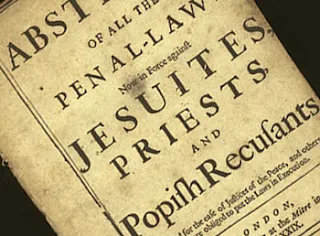
After the defeat of the Jacobites at the Battle of the Boyne in 1690, the socioeconomic dominance of the Protestant Ascendancy was built into the legal system through the passing of various Penal Laws. The Protestant Ascendancy were Anglo-Irish families of the Anglican Church of Ireland, whose English ancestors had settled Ireland through the Plantations, and had taken control of most of the land. The Penal Laws ensured that the overwhelming majority of Ireland's population, Roman Catholics, were excluded from land ownership, and any form of socioconomic or political power. The second-largest group, the Presbyterians in Ulster, could own land and businesses, but could not vote and had no political power.
The Penal Laws reinforced the Protestant Ascendancy by concentrating property and public office in the hands of those who, as communicants of the established Church of Ireland, subscribed to the Oath of Supremacy. This Oath acknowledged the British monarch as the "supreme governor" of matters both spiritual and temporal, and abjured "all foreign jurisdictions [and] powers" — by implication both the Pope in Rome and the Stuart "Pretender" in the court of the King of France.
Many of these Penal Laws were on the books before 1695, but their enforcement was inconsistent. But the 1695 passage of the Settlement of Ireland Act, which declared all acts and laws made by previous Parliaments to be void, cleared the decks for a new political and economic order in Ireland. This act was accompanied by two others, An Act for the Better Securing the Government, by Disarming Papists and An Act to Restrain Foreign Education, that laid the groundwork for the rigid, systematic, and continuous enforcement of this body of laws for over a century.
From An Act for the Better Securing the Government, by Disarming Papists:
For preserving the public peace, and quieting the kingdom from all dangers of insurrection and rebellion for the future; be it enacted by the King's most excellent Majesty, by and with the advice and consent of the lords spiritual and temporal and commons in this present Parliament assembled, and by authority of the same, that all Papists within this kingdom of Ireland shall, before the first day of March next ensuing, discover and deliver up to some justice or justices of the peace, or to the mayor, bailiff, or head officer of the county, city, town corporate, or place respectively where such papist chall dwell and reside, all their arms, armour, and ammunitionof what kind soever the same be, which are in his or their hands or possession . . .
From An Act to Restrain Foreign Education:
Whereas it has been found by experience that tolerating at Papists keeping school or instructing youth in literature is one great reason of many of the natives continuing ignorant of the principles of the true religion . . no person of the Popish religion shall publicly teach school or instruct youth . . . upon pain of 20 pounds and prison for three months for every such offence . . .
A sample of the Penal Laws
- Catholics could not hold public office (Member of Parliament, Judge, Solicitor, Jurist, Barrister, Sheriff, Member of a Town Council, or Civil Servant)
- Catholics could not vote or be elected to office.
- Catholics could not buy any land.
- Catholics could not own a horse worth more than £5.
- Catholics could not travel more than five miles from their homes.
- Catholics could not lease land for longer than 31 years, and the annual rent was equal to 2/3 of the land's value.
- Catholics could not hold arms or be members of the armed forces.
- Catholics could not establish schools or send their children abroad for education.
- Catholics could not marry a Protestant.
- Catholics could not be an orphan’s guardian.
- Catholics could not live in many provincial towns.
- Any Protestant seeing a Catholic tenant farmer working land that, in their opinion, yielded crops worth more than 1/3 the annual rent, could enter the farm, and, by swearing to the fact of that yield, could take possession of the farm.
- Any Protestant could take the horse of a Catholic, no matter how valuable the animal was, by paying £5.
- Catholics were fined £60 if they did not attend an Anglican Church of Ireland worship service at least once each month.
- Catholics (and Dissenters) were required to pay tithes to the Anglican Church of Ireland.
- Existing Catholic clergy were registered and required to take an oath of loyalty to the Anglican Church of Ireland. But those clergy considered especially dangerous, the members of the Catholic hierarchy, members of monastic communities, and all Jesuits, were exiled.
- Any Catholic priest who emigrated to Ireland was to be hanged.
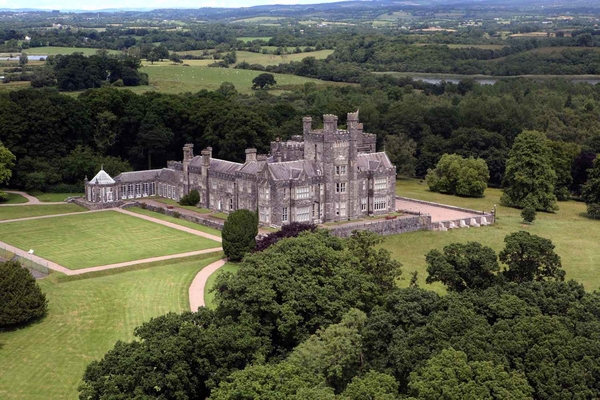
A Big House: Crom Castle in Co. Fermanagh
Rise of the "Big Houses"
Around 4,000 "Big Houses" were built in the first half of the 18th century by the ruling Protestant ascendancy classes who came to power after the Cromwellian invasion of Ireland. They ranged in size from palatial estates to houses that were more modest but still significantly larger than the typical Irish home of the time.
But the indulgent lifestyles of the Anglo-Irish that played out in the houses eventually succumbed to new social realities. Successive land acts enabled Irish Catholics to purchase land, while at the same time many landlords were digging themselves deeper and deeper into debt by spending so much to upgrade and maintain their houses. Without the income from vast swathes of land, and the labor of their former Catholic tenants to support their extravagance, the landed classes and their houses began to fall into decline.
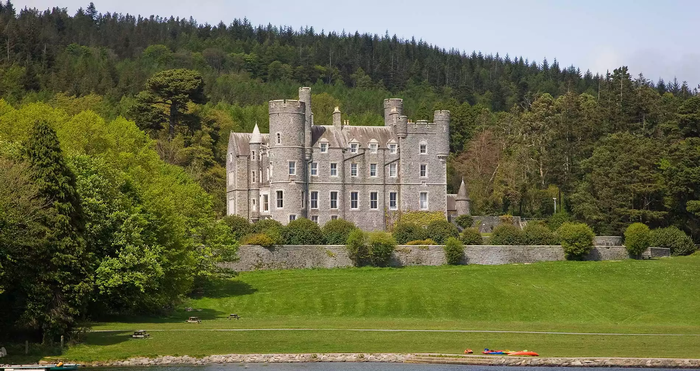
Castlewellan Castle in Co. Down
This slow decay took place over generations, and was the primary subject matter of Irish Big House novels. Maria Edgeworth's Castle Rackrent is a great example of the genre. A sense of dissipation and paranoia sits just below the surface of these novels; their authors almost invariably pitch the Anglo-Irish as fighting a rear-guard action against an inevitable outcome. Picking apart the tightly-woven connections between the Big House novels and the Irish Gothic (see below) is a fairly recent trend in literary Irish studies.
The Big House has always been a popular theme in fiction. Evelyn Waugh’s Brideshead Revisited, EM Forster’s Howards End and Daphne Du Maurier’s Rebecca may not be at the top of everybody’s reading lists but the place these books hold in popular culture is undeniable.
The place of the Big House in Ireland’s cultural psyche, and in our fiction, is a thornier issue. This is perhaps due to their use as a representation of more than simply the seats of the ruling classes but also as mirror-images of the fall from power of Anglo-Irish society.
— Antoinette Tyrell, "The Big House’s Place in Irish Fiction and Our Cultural Psyche." The Irish Times, 11 February, 2019.
The Orange Order
During the latter half of the 18th century, a group of tenants in Ulster emerged who attempted to force their landlords to maintain them in their farms against the claims and bids of Roman Catholic competitors who were again legally entitled to hold land. This agitation gave rise to the Orange Order (popularly called the Orangemen), which was founded in 1795 in defense of the Protestant Ascendancy. Increasingly the Orange Order linked the Protestant gentry and farmers while excluding Catholics from breaking into this privileged ring.
Grattan's Parliament (1782-1800)
A period of legislative independence for the Parliament of Ireland, fostering some sense of national identity, though primarily among the Protestant elite.
The 1798 Rebellion
It's been said that the Irish don't love victory as much as they love a noble failure. If this is true, it explains why the United Irishmen Rebellion, or the Croppy Rebellion, or the 1798 Rebellion, is still so resonant within the Irish national psyche. This rebellion was certainly one of the most threatening to English hegemony, because it was the first time that Catholics and Protestants united against the Crown. The Society of United Irishmen, inspired by the American and French revolutions, was founded in 1791, with the first two chapters in Belfast and then in Dublin. Members were primarily middle class, but the Belfast society was mostly Presbyterian, and the Dublin society was a mix of Catholics and Protestants. Their initial objectives were minimal: suffrage for Catholics and those who did not own property. They were deliberately non-sectarian, their motto being, as their leading member Theobald Wolfe Tone put it,
to unite Catholic, Protestant, and Dissenter, under the common name of Irishman.
Some of their early demands were granted by the Irish parliament. Catholics were given the right to vote in 1793, but only if they owned land worth more than 40 shillings. They were allowed to pursue higher education, obtain degrees, and serve in the military and civil service. But they still could not hold any public office or sit in Parliament.
The United Irishmen were banned and went underground in 1794. Wolfe Tone went into exile, first to America and then to France, where he lobbied for military aid for revolution in Ireland. The Society then claimed that their goal was a fully independent Irish Republic. They began organizing a clandestine military structure, working with other secret societies, both Catholic (the Defenders) and Protestant (the Peep of Day Boys and the Orange Order), to recruit more foot soldiers for the hoped-for revolution. As a result, while the majority of the United Irishmen’s top leadership remained Protestant, their foot soldiers, except in northeast Ulster, became increasingly Catholic.
In 1796 Wolfe Tone returned from France with a large fleet set on invasion, with almost 14,000 troops. But the fleet ran into a series of terrible storms, and many ships were wrecked off Bantry Bay in County Cork. iThois forced them to return to France. The government in Dublin, shocked by how close they had come to being invaded, responded with a vicious wave of repression, passing an Insurrection Act that suspended habeas corpus and other peacetime laws.
British troops, along with local militia, and a force that was fiercely loyalist and mostly Protestant (the Yeomanry), attempted to terrorize any would-be revolutionaries in Ireland who might aid the French in the event of another invasion. The Crown forces’ methods included burning the houses of Catholics and Catholic churches, summary executions, nar-hanging, and "pitch-capping," where tar was placed on a victim’s scalp then set on fire.
Their rebellion was supposed to begin on May 23, 1798, but the Dublin authorities became aware of their plans and arrested most of the senior United Irishmen leadership on May 22. With their leasders mostly in prison or in exile, the rising flared up in in a localized and uncoordinated manner. Large bodies of United Irishmen rose in arms in the counties around Dublin; Kildare, Wicklow, Carlow and Meath, but Dublin city itself, which was heavily garrisoned and placed under martial law, did not stir.
The only successful implementation of their plans came in County Wexford, and even that was limited. There the insurgents defeated some militia and Yeomanry units and took the towns of Enniscorthy and Wexford. The leadership of the Wexford rebels was both Protestant—their military leader, Harvey Bagenal—and Catholic—several Catholic priests like Father John Murphy. The majority of the fighting force was Catholic, united by their outrage at the sectarian atrocities committed in the previous months by the Yeomanry.
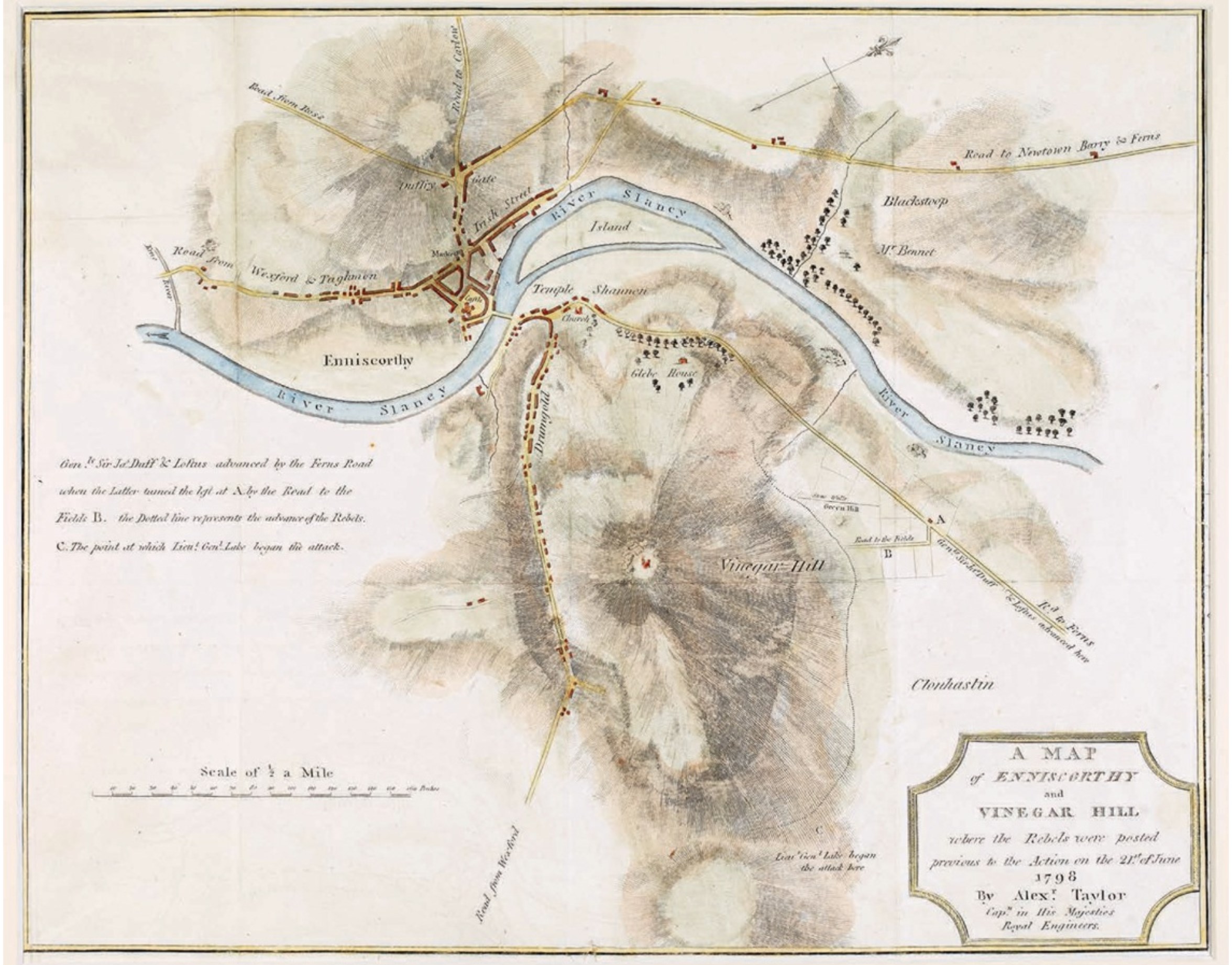
But these rebels failed to take the towns of New Ross and Arklow, despite determined and costly assaults, and remained bottled up in the southeastern corner of the island. The Wexford rebellion was smashed about a month after it broke out, when over 13,000 British troops converged on the main rebel camp at Vinegar Hill on June 21, 1798. They rained artillery on the rebels,but were not able to capture all of them. Some who escaped tried to spread the rebellion into County Kilkenny, and others attempted to join up with United Irishmen in counties Kildare and Meath, before finally seeking refuge in the Wicklow mountains. Guerrilla fighting continued, but the main rebel stronghold had fallen.
In the north, the mainly Presbyterian United Irishmen launched their own uprisings in counties Antrim and Down, in support of Wexford in early June. However, after some initial success, they were defeated by government troops and militia.
The main fighting in the 1798 rebellion lasted just three months, but the deaths ran into the tens of thousands. Estimates range from 10,000 to 70,000 dead rebels. Of course, thousands more were injured, and thousands of farms and homes were burned. Thousands more former rebels were exiled to Scotland or transported to penal colonies in Australia.
While the radicals of the 1790s had hoped that religious divisions in Ireland could be put aside, the fierce sectarian violence that took place on both sides during the rebellion actually hardened sectarian animosities. Many northern Presbyterians began to see the British connection as less potentially dangerous for them than an independent Ireland, where they would be a minority.
The United Irishmen’s hope of founding a secular, independent, democratic Irish Republic therefore ended in total defeat. But their foundation of the ideology of Irish republicanism would have a long and enduring legacy upon Irish politics.
Notable Authors and Works
Aogán Ó Rathaille (c. 1670-1726):
A leading poet of the "Hidden Ireland," one of the last and greatest poets of the Gaelic order, and a master of the aisling. He's consistently backward-looking, writing praise poems in hope of patronage. He was always looking to have the land confiscated from his ancestors returned to him, but that never maaterialized. So of course he was also writing laments about the death of the Gaelic order, because at its height poets like him held positions of honor. Instead, he travelled throughout Munster as a migrant worker. When there was no work, he was sometimes reduced to begging. His praise poetry might have made him wealthy in an earlier century, but during his time it earned him things like a pair of shoes, or room and board for a week.
One of his best poems, “Gile na gile" ("Brightness of brightness"), blends two forms: it's a lament for the loss of the Gaelic order, but in the form of a bright vision seen by him in his wandering. He supposedly wrote "Cabhair ni Ghairfeadh" (“No help I’ll call”) on his death-bed [‘I shall not cry for help until placed in a closed coffin]’; widely regarded as one of the latest and greatest poets of the Gaelic order; bur. Muckross Abbey
The event that destroyed Ó Rathaille's universe was the defeat by William of Orange of James II at the Boyne in July 1690, followed by the rout of the Jacobites at Aughrim in 1691 and the betrayals that followed the Treaty of Limerick. In west Munster virtually all the Old Irish families and many of the Old English – who by then had made marriage alliances with local culture, language, and religion – had been and afterwards remained committed to King James. Many, including the main branches of those families whom Ó Rathaille considered his ‘chieftains’ and sponsors, the MacCarthys and Brownes (Lords Kenmare) of Kerry, were partly or wholly dispossessed of their lands, at least for their lifetimes, and driven into exile in continental Europe. They were replaced by the New English planters of the Hanoverian age and their Irish carpetbaggers.
The new masters despised the old order and its traditional patronage of men of learning and poets such as Ó Rathaille, who attempted to keep the dream of imminent invasion alive among the old Gaelic order and the Old English in Munster.
— Michael Lillis, "Ó Rathaille, Aogán" in Dictionary of Irish Biography, https://www.dib.ie/biography/o-rathaille-aogan-a6427
Eoghan Rua Ó Súilleabháin (1748-1784)
Another prominent aisling poet, known for his lyrical and often defiant verse. There is a tradition that he established a school at Gneevgullia in his native parish but had to close it because the local clerics were offended by his reputation for sexual misconduct. He then appears to have spent several years as a migrant laborer, mainly in Co. Cork and Co. Limerick, while working as a teacher or scribe when he could. He served as a marine in the Royal Navy (there's another tradition that he enlisted in order to evade the relatives of a woman whom he had seduced), and fought in the Battle of the Saints (1782) when Admiral Rodney defeated the French fleet in the Caribbean. He wrote about it in the ode "Rodney's Glory." The contrast between his views in this English-language composition and those in his aislingí reflects the very different audiences for which they were written.
Ó Súilleabháin was arguably the most popular poet in 18th-century Munster, and his rakish lifestyle secured him a lasting place in the folk memory. Some of his political poems and several romantic compositions addressed to women whom he admired have survived, but some of his bawdier works remain unpublished. However, his best works were his Jacobite aislings, which usually followed the same formula: an allegorical figure of Ireland appears to the poet and announces the imminent arrival of a French or Spanish fleet to restore the Stuart pretender.
Ó Súilleabháin also cast a very long shadow. Yeats used aspects of his reputation in his stories of Red Hanrahan (his invented alter ego), whose given name is “Owen” and who carries a copy of Virgil in his pocket, “the hedge schoolmaster, a tall, strong, red-haired young man.” The hedge schoolmaster in Brian Friel's Translations is also modelled on him. And in Synge's The Playboy of the Western World, Pegeen Mike compares the Christy Mahon (the titular playboy) to Ó Súilleabháin:
If you weren’t destroyed traveling, you’d have as much talk and streeleen, I’m thinking, as Owen Roe O’Sullivan or the poets of the Dingle Bay, and I’ve heard all times it’s the poets are your like, fine fiery fellows with great rages when their temper’s roused.
Jonathan Swift (1667-1745)
A foundational figure in Anglo-Irish literature, known for his satirical prose.
After being granted a BA from Trinity College Dublin "by special grace" – because he had such discipline problems, he took a Doctor of Divinity degree there. Then he moved to England to become the secretary to Sir William Temple, one of England's most distinguished political diplomats, who was living in retirement at Moor Park, Surrey. This was to become one of the most important and enduring influences of his entire career, as he worked as Temple's amanuensis, helping him with correspondence, the contents of the extensive library, and a variety of secretarial duties. Swift's first literary compositions appear during these years.
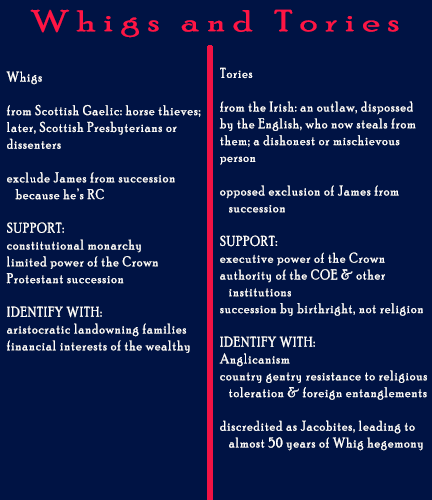
His literary skills were recognized by the Tories; he became their chief propagandist, and the most influential political writer in Britain, spending time with the leading politicians at court and the other literary figures of the time, notably Alexander Pope, Dr John Arbuthnot, and John Gay, with whom he formed the Scriblerus Club, dedicated to the satirical arts.
Swift refused any payment for his work for the Tories, hoping instead to be rewarded for his work with a bishopric in England. Instead, he was appointed Dean of St. Patrick's Cathedral in Dublin, which was quite a disappointment to him. He spent a few years getting to know Ireland and trying to improve the cathedral and its grounds. But by the 1720s he was writing on Irish politics, with a series of tracts including A Proposal for the Universal Use of Irish Manufacture (1720), where he advocated a boycott of English imports and a greater reliance on Irish manufacturers, especially in woollen and linen goods. His most famous intervention came with The Drapier's Letters (1724), a series of seven pamphlets written against an English attempt to mint a new copper coinage for Ireland. To Swift, this was proof that Ireland was being treated as a colony and not, as the Drapier argued it should be, as an independent kingdom. This new colonial nationalism was articulated most eloquently and most radically in the fourth pamphlet, "To the Whole People of Ireland," in which the Drapier asserted the principles of freedom and equality under the crown. The lord lieutenant of Ireland saw this piece as inciting rebellion or violence against the government, and offered a reward of £300 (over $86,000 in 2025 dollars) for the disclosure of the name of the author, but the reward remained unclaimed. His extensive travels throughout Ireland, where he witnessed recurrent famine and extreme poverty, seem to have informed much of the outrage behind his most notorious Irish pamphlet, A Modest Proposal, first published in 1729 in Dublin. This was Swift's last significant pamphlet on Ireland's human economy, a savage indictment of administrative and moral failure to reform the country.
At the same time Swift was writing satirical fiction, he was also working for five years on Travels into Several Remote Nations of the World, by Lemuel Gulliver, which was an instant success in 1726, going through three editions in its first year. Most of his satire on contemporary political figures is lost on modern readers, but as a commentary on the common human condition it may be Swift's greatest legacy.
Swift stopped writing 10 years before his death in 1745. The last decade of his writing career was devoted almost entirely to poetry. "Verses on the Death of Dr Swift" was first written in 1731, and published in various editions during the following years. In this poem, Swift imagines what people will say about him once they hear of his death. After a satirical survey of the gossip and relief, the poem concludes with a powerful self-defense, presentig himself as a public-spirited and patriotic man who
gave the little wealth he had,
To build a house for fools and mad:
And showed by one satiric touch,
No nation wanted it so much.
In his will, where he declares himself to be "of sound mind, although weak in body," Swift bequeathed £12,000 ($3.9M in 2025 dollars) for the establishment of St Patrick's Hospital, the first asylum for the mentally ill in Ireland, which opened in 1746, a year after his death.
I realize I am giving these final three very short shrift, but there is only so much material we can cover.
Oliver Goldsmith (c. 1730-1774)
Poet, playwright (She Stoops to Conquer), and novelist, contributing to the broader English literary scene but with Irish roots.
Richard Brinsley Sheridan (1751-1816)
Celebrated playwright (The School for Scandal, The Rivals) whose work reflects the wit and social commentary of the era.
Edmund Burke (1729-1797)
Philosopher and statesman, whose writings on politics and society, while not exclusively "Irish literature," were deeply informed by his Irish background and the political situation in Ireland.
A New Genre: The Irish Gothic
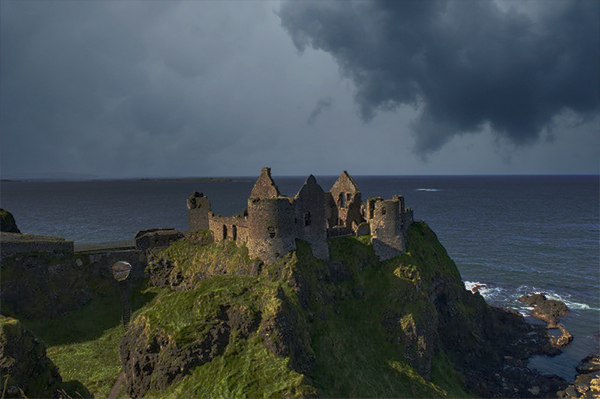
Most literary historians date the beginnings of the Gothic novel to Walpole's The Castle of Otranto, in 1764. And in English Lit, they usually jump next to Shelley's Frankenstein, published in 1818. The half-century between those two classics should not be passed over in silence, because this period saw the rise of the Irish Gothic. This brand of fiction in Ireland is important both for the social class it stemmed from, and for the authors themselves.
The Irish Gothic novel developed at the same time that Walpole was writing, a time in Ireland when the Anglo-Irish, or the Protestant Ascendancy, were caught in a trap of their own making. They weren't English enough for the English, and they weren't Irish enough for the (Catholic) Irish. As a genre, the Gothic is singularly focused on the theme of identity, and has always been a vehicle for expressing and examining repressed societal anxieties. Both of these traits made it a perfect vehicle for Irish Anglicans to respond to their "neither fish nor fowl" state. These novels were spun up, in some sense, to allegorize the concerns of a minority population who (rightly or wrongly) thought themselves threatened by the native Irish Catholics. To be fair, their economic control over the native Irish resulted in rebellion after rebellion, and it was only a matter of time before one of those rebellions actually succeeded. James F. Wurtz notes that "Irish writers often turned to the Gothic for images and narratives which would enable them to find new ways of articulating a stable identity in the midst of tremendous change."
Early Irish Gothic fiction tended to present Catholics as the strange—almost diabolical—Other. Later writers such as Joseph Sheridan Le Fanu explored postcolonial concerns regarding his own class by depicting them simultaneously as the causers of and sufferers from their own colonial misdeeds. This idea was broached by Thomas Leland (an Irish Anglican priest) in his History of Ireland from the Invasion of Henry II, which was criticized by both Anglicans and Catholics. Maria's Edgeworth's ambiguous Catholic narrator of Castle Rackrent is inscrutable; there are hints of his complicity in bringing down a once-proud Anglo-Irish house, but nothing is certain. In a number of other novels of the day, the Anglo-Irish are portrayed as victims or dupes, with responsibility for the decline of their order subtly pointing to the Catholic peasantry, but always lacking any hard or actionable proof. This sense of collective paranoia is the heartblood of the Gothic.
But beyond the irony of oppressors claiming victimhood, the Irish Gothic is significant for another reason: the popularity of women writers. Almost a century before Nathaniel Hawthorne would bemoan in 1855 that "America is now given over to a damned mob of scribbling women," Irish fiction was dominated by writers like Elizabeth Griffith, Anne Fuller, Regina Maria Roche, Mrs. Sarah Green, Anna Milliken, Mrs. F.C. Patrick, Catharine Selden, Maria Edgeworth, Catherine Cuthbertson, Sydney Owenson, Henrietta Rouvière Mosse, Marianne Kenley, Elizabeth Plunkett, Lady Caroline Lamb, and Alicia Le Fanu. Griffith's Amana was published in the same year as The Castle of Otranto; Le Fanu's Helen Monteagle in the same year as Frankenstein.
I could suggest that these Anglo-Irish women were so successful within the Gothic genre because they were doubly ill at ease; both their gender and their social class made them so. The English, the Irish, and even the men of their own social class treated them as something beneath or between any real agency.

* These guides use five special symbols, taken from Mark Williams' Ireland’s Immortals: A History of the Gods of Irish Myth, Princeton UP, 2016.
ə |
the uh sound at the end of sofa |
|
a throaty gh sound, similar to the -ch in Scots loch but further back and down in the gullet. Not to be confused with the letter "y" |
kh |
the ch in Scots loch, spelled with a k– to avoid confusion with the ch in English child. |
ð |
the th– sound at the start of those, that, and than, which is different from the th– sound at the beginning of thick, thin, or think. |
ʸ |
indicates that the preceding consonant is "palatal," that is, accompanied by a y-glide like the m in mew or the c in cute (contrast moo and coot). This often occurs at the end of a word: in a form like the place-name Crúachain, which would be KROO-əkh-ənʸ. The y is there simply to indicate that the final consonant is pronounced like the first n in onion; it does not add a syllable. |